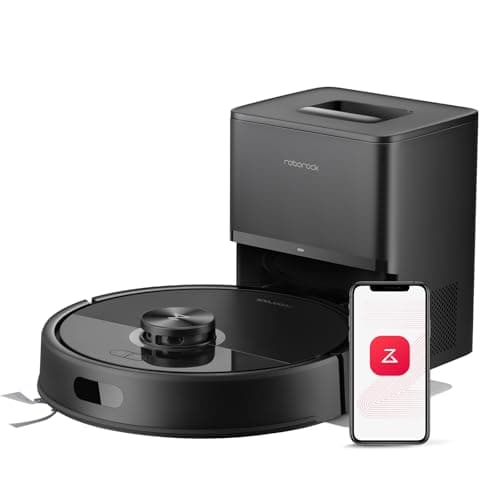
Tracked litter is the one kind of debris that is heavy enough to need real suction, arrives every single day, and is ruined by the mop your machine came with.
By Scooter M., Enthusiast - published September 10, 2026
We have not tested these machines. Everything here comes from published specifications, manufacturer manuals and retailer listings, all cited below. Prices last verified September 21, 2026.
How this is funded: if you buy through a link here we may earn a commission, at no extra cost to you. It does not change which machines we recommend or what we say about them. Full disclosure.
For tracked cat litter the best machine under $300 is the Roborock Q7 M5+: 10,000Pa published, a self-emptying dock so a daily job does not become a daily chore, and the only anti-tangle design here that covers both brushes, which matters because litter arrives in a house that also has cat hair in it. Whatever you buy, draw a no-mop zone around the litter box - a damp pad dragged through litter makes a paste that is worse than what you started with.
Litter is a genuinely different cleaning problem from dust, and most rankings treat it as the same one. Here is what actually changes.
#
Product
Best for
Score
Price
01
Roborock Q7 M5+10,000Pa, a self-emptying dock, and the only anti-tangle system here that treats the side brush as part of the problem.
#ad No live price for this one as of September 21, 2026. How we are funded
02
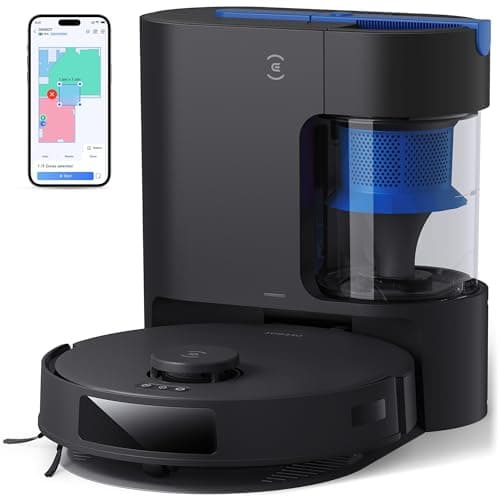
Ecovacs DEEBOT N20 PlusA self-emptying dock with no bag in it. Over three years that is the difference between this and everything else here, and it is not close.
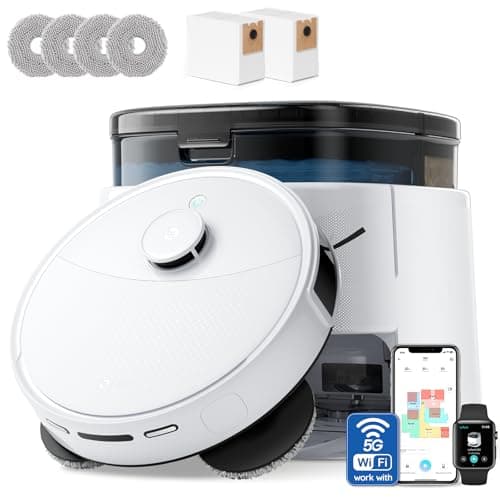
Lefant M312,000Pa and a dock that washes the mop in 45-degree water. The highest specification here by a distance, from the least established brand here.
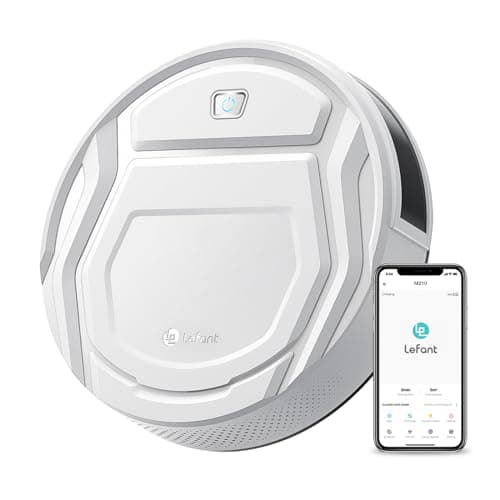
Lefant M210A brushless suction port instead of a roller brush, which is why it handles hair better than machines twice its price. It has no map and never will.
Scores come from the published rubric on How We Pick: suction 25%, navigation 25%, pet hair 20%, running cost 20%, setup 10%. They are editorial judgments about published specifications, not test results.
Why litter needs different specifications
It is heavy. Clay and crystal litter granules weigh far more per particle than dust or hair. This is one of the few jobs in this category where a published suction figure is genuinely predictive rather than marketing - a machine that lifts dust off a hard floor can drive straight over a scattering of clay granules and leave most of them.
It arrives every day, in the same place. Tracking is continuous, concentrated in a two-meter radius around the box, and it does not care that you cleaned yesterday. That makes frequency and a dock worth more here than on almost any other page of this site - if you have to empty a bin by hand every day, you will stop running the machine within a fortnight.
It fills the bin fast. Granules are dense, so bin volume runs out long before a dust-based estimate would suggest. A machine with a self-emptying base turns that from a daily task into a quarterly one.
It comes with cat hair. A litter household is a cat household, so brush design still matters. Our pet hair ranking covers that side in full.
The mop is the mistake nearly everyone makes
This is the single most useful thing on the page. A robot vacuum's mop is, on almost every machine under $300, a damp microfiber pad dragged behind the machine. Run that through an area with tracked litter and you get a wet, gritty paste smeared across the floor - and on clumping clay litter, a paste that sets.
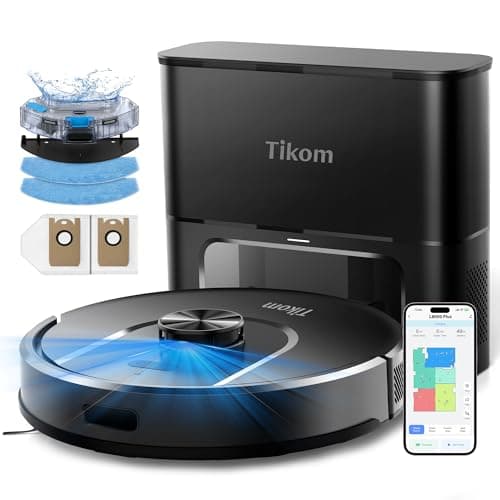
The fix is a no-mop zone drawn in the app around the litter box, which every mapping machine on this page supports. The Tikom L8000 Plus names no-mop zones separately from no-go zones, which is exactly right for this job: the machine still vacuums the area, it simply stops laying water on it. A machine with no map cannot do this at all, which is why one otherwise decent budget pick is on the skip list below rather than in the ranking.
What each pick brings to a litter-tracking problem
Machine
Published suction
Dock
Litter-relevant note
Roborock Q7 M5+
10,000Pa
2.7 L bag, 7 to 9 weeks
Anti-tangle on both brushes
Ecovacs DEEBOT N20 Plus
8,000Pa
Bagless, no consumable
20 mm threshold climb clears most box mats
Tikom L8000 Plus
6,000Pa max
3 L bag, up to 90 days
Separate no-mop zones in the app
Lefant M3
12,000Pa
3.2 L bag, up to 90 days
Highest published figure here
Lefant M210
Not published
None - manual bin
Brushless inlet, 2.99 in tall
All figures read from each manufacturer's own listing. Pascal ratings have no shared test standard - see our suction explainer.
Where the highest number is not the best answer
The Lefant M3 publishes 12,000Pa, the biggest figure on this site, and it sits fourth here rather than first. Two reasons. Pascal ratings have no shared test standard, so a 20% higher number from a different manufacturer is not a 20% better result - our suction explainer works through why. And its headline feature is a dock that washes the mop pad in hot water, which is a genuinely good feature aimed at a problem you should be solving with a no-mop zone instead.
The Ecovacs DEEBOT N20 Plus is the value answer at second. 8,000Pa published, a named anti-tangle brush, a 20 mm threshold climb that gets it over most litter mats, and a bagless dock with no consumable - which in a house where the dock fills faster than usual is worth more than it looks.
The cheap option, honestly framed
If the litter area is a small patch of hard floor and you are not trying to clean a whole house, the Lefant M210 is a legitimate answer at the bottom of the ladder. Its brushless inlet has nothing for hair to wrap around, it is 2.99 inches tall so it gets under the litter cabinet, and it costs a fraction of the top pick.
What you give up is everything else on this page: no map, no zones, no dock, and no published suction figure on a job where suction is the specification that matters. Buy it for a bathroom or a utility room where the box lives. Do not buy it as a whole-house answer.
Setting it up around a litter box
Draw the no-mop zone first, before the first mop run rather than after. On clumping clay the first mistake is the one that sets.
Keep a mat under the box and shake it out yourself. The mat catches the coarse fraction; the robot handles what escapes it.
Schedule the run for an hour after the cat's usual visit, not immediately - a machine driving through fresh litter scatters more than it collects.
Empty or change the dock bag on schedule. Litter is dense, so the dock fills faster than the manufacturer's dust-based interval suggests.
Check the brush weekly, not monthly. Grit accelerates wear on a brushroll far faster than dust does.
What we could not verify
We have not handled these machines and we have run no litter pickup test. Every figure above is read from the manufacturer's own listing and cited below. No manufacturer on this site publishes a pickup rate for granular debris specifically, so the ranking uses published suction, bin and dock capacity, brush design and zone control as the evidence available - not a measured result. How we pick has the weights.
#ad No live price for this one as of September 21, 2026. How we are funded
10,000Pa, a self-emptying dock, and the only anti-tangle system here that treats the side brush as part of the problem.
Published specifications
Suction
10,000Pa HyperForceSource: Manufacturer listing
Navigation
PreciSense LiDAR with real-time mappingSource: Manufacturer listing
Self-emptying
2.7 L sealed bag, manufacturer states 7 to 9 weeksSource: Manufacturer listing
Anti-tangle
JawScrapers main brush plus a stated 0% hair-tangling side brushSource: Manufacturer listing
Mopping
Vacuum and mop in one pass, 3 water flow settingsSource: Manufacturer listing
What it gets right
Both brushes are designed against tangling. Every other anti-tangle claim here covers only the main brush, and the side brush is where long hair actually wraps
10,000Pa published, matching machines at three times the price
Roborock's app is the most capable in this group after iRobot's, and its maps survive furniture moves
Vacuums and mops in a single pass rather than two runs
What it gives up
2.7 L and 7 to 9 weeks is a shorter interval than the Tikom L8000 Plus manages
No structured-light obstacle avoidance at this price - that is the Q10's feature
Sealed bags are a recurring cost
The mop still cannot be washed by the dock
Our scoring
Suction9.0
Navigation8.5
Pet hair8.5
Running cost6.5
Setup8.0
Weights and the arithmetic behind the total are published on How we pick so you can recompute this yourself.
Who it is for: A shedding dog or a long-haired cat, on any floor type.
Skip it if: your home is cluttered at floor level. LiDAR maps walls, not socks and charging cables, and without obstacle avoidance this machine will eventually eat one.
3 suction levels, 3 water flow settingsSource: Manufacturer listing
What it gets right
Ninety days between bag changes is 50% longer than the Tapo docks and beats most flagships
Five saved maps handles a three-story house, which is unusual under $250
Separate no-mop zones, so you can keep it off a rug without banning it from the room
6,000Pa published, with automatic carpet boost
What it gives up
Bags are still a recurring cost, just a less frequent one
150 minutes is mid-pack, and a big home will need the resume feature to finish
A conventional main brush - no anti-tangle geometry is claimed
Tikom is a small brand; spare-part availability in three years is a genuine unknown
Our scoring
Suction8.0
Navigation8.0
Pet hair6.5
Running cost6.5
Setup7.5
Weights and the arithmetic behind the total are published on How we pick so you can recompute this yourself.
Who it is for: A multi-floor home where the dock is somewhere inconvenient and you want to visit it as rarely as possible.
Skip it if: you have long-haired pets. Nothing in this machine's published specification addresses hair wrap, and at a similar price the Roborock Q7 M5+ and the Ecovacs N20 Plus both name an anti-tangle mechanism.
3.2 L bag, manufacturer states up to 90 daysSource: Manufacturer listing
Mop care
45C hot water wash with cool-air dryingSource: Manufacturer listing
Battery / runtime
5,200 mAh, up to 220 minutesSource: Manufacturer listing
Mopping coverage
Manufacturer states 2,368 sq ft (220 m2) per tankSource: Manufacturer listing
Wi-Fi
Dual band, 2.4 GHz and 5 GHzSource: Manufacturer listing
What it gets right
12,000Pa is a flagship-tier published figure at a sub-$250 price
A mop-washing dock at this price is genuinely unusual - most stop at self-emptying
Cool-air drying rather than heat, which is what stops a pad going stiff and smelling
Dual-band Wi-Fi, which sounds trivial until you own a mesh network that keeps handing it to the 5 GHz radio
What it gives up
A washing dock is plumbing. Two tanks, a tray and a pad to keep clean, and more to go wrong
Pa figures are not comparable between manufacturers - there is no shared test standard, and a big number is not automatically better cleaning
Still buying 3.2 L bags
The least established brand here for warranty and spare parts
Our scoring
Suction9.0
Navigation8.0
Pet hair7.0
Running cost6.0
Setup7.0
Weights and the arithmetic behind the total are published on How we pick so you can recompute this yourself.
Who it is for: A hard-floor home where mopping is the actual point and the dock has somewhere to live.
Skip it if: you want fewer chores rather than better ones. A self-washing dock removes the worst job and adds three small ones, and plenty of people would rather rinse a pad in the sink.
The brushless inlet has nothing for hair to wrap around, so there is no brushroll to cut free every fortnight
2.99 inches tall clears most sofa and bed frames that stop taller machines
Lithium iron phosphate cells, a chemistry that tolerates daily full cycles better than the usual lithium-ion
Nothing to subscribe to and no dust bags to buy
What it gives up
No published suction rating at all, which for a machine sold on suction is a strange omission
No mapping. It covers a room by bouncing around it, so a large floor plan takes several passes
The manufacturer says not to use zigzag mode on carpet, which rules out its most efficient pattern on rugs
Brushless inlets are weaker on embedded carpet grit than a beater bar
Our scoring
Suction5.0
Navigation3.5
Pet hair7.5
Running cost8.5
Setup8.0
Weights and the arithmetic behind the total are published on How we pick so you can recompute this yourself.
Who it is for: A one-bedroom apartment with hard floors, a shedding pet, and a hard budget ceiling under $100.
Skip it if: you have more than about 800 square feet of open floor, or any medium-pile carpet you actually want cleaned rather than skimmed. Without a map it will miss areas, and without a brushroll it will not dig.
Questions people actually ask
+−What is the best robot vacuum for cat litter?
Under $300, the Roborock Q7 M5+. It publishes 10,000Pa, which matters because litter granules are far heavier than dust, it empties itself into a sealed bag for weeks at a time, and its anti-tangle design covers both brushes for the cat hair that comes with the litter.
+−Can a robot vacuum handle cat litter?
Tracked litter on hard floors, yes - that is exactly the daily maintenance job these machines are good at. What none of them will do is clean inside or under the box, and no machine at this price deep-cleans litter ground into carpet pile.
+−Should I mop near the litter box with a robot vacuum?
No. A damp pad dragged through tracked litter makes a gritty paste, and on clumping clay it sets. Draw a no-mop zone around the box in the app - every mapping machine on this page supports one, and a machine without a map cannot do it at all.
+−How much suction do I need for cat litter?
More than for dust, because the granules are heavy. Among machines that publish a figure, this page ranks from 5,000Pa upward and we would not go below that for litter. Bear in mind Pascal ratings have no shared test standard, so treat the number as an indication rather than a measurement.
+−Do I need a self-emptying dock for cat litter?
It is the feature worth paying for here. Litter is dense and arrives daily, so an onboard bin fills quickly - and a machine you have to empty by hand every day is one you stop running. A dock turns that into a job you do every couple of months.
+−Will a robot vacuum stop litter tracking?
It will manage it, not stop it. The granules leave the box on the cat, so the source keeps producing. A mat under the box plus a daily robot pass over the surrounding hard floor is the combination that keeps it under control.
Sources
Every specification quoted above was read off one of these documents on the date shown. Where a manufacturer does not publish a figure, this site says "Not published" rather than estimating it.