Every listing leads with it and there is no shared test standard behind any of them. Here is what the number is, and what it is worth.
By Scooter M., Enthusiast - published September 2, 2026
We have not tested these machines. Everything here comes from published specifications, manufacturer manuals and retailer listings, all cited below. Prices last verified October 18, 2026.
How this is funded: if you buy through a link here we may earn a commission, at no extra cost to you. It does not change which machines we recommend or what we say about them. Full disclosure.
Pa - pascals - measures the pressure differential a vacuum's fan can generate, usually with the inlet sealed. It is a measure of how hard the machine can pull, not of how much dirt it picks up. There is no shared test standard between manufacturers, so two brands' figures are two different measurements that happen to share a unit.
What the number physically is
Seal the vacuum's inlet completely and run the fan. The fan lowers the air pressure inside the machine relative to the room, and the difference is measured in pascals. Twelve thousand pascals is a difference of about 12 kilopascals - roughly 12% of atmospheric pressure.
That tells you something real about the fan. What it does not tell you is how much dirt reaches the bin, because a sealed-inlet measurement removes airflow from the equation entirely - and airflow is what actually moves debris. A machine can have high sealed pressure and mediocre airflow if its ducting is restrictive or its inlet is badly positioned.
Why the numbers are not comparable between brands
No shared standard. There is no equivalent to the automotive fuel-economy cycle here. Each manufacturer chooses its own method and does not publish it.
Peak versus sustained. Most published figures are the peak the machine reaches in its loudest mode. Tapo is unusually explicit that 5,300Pa is an Ultra-mode figure; others simply state a number.
Measurement point. A figure taken at the fan and a figure taken at the floor inlet are different numbers for the same machine, and manufacturers rarely say which they used.
No third-party verification. Nobody checks. The figure on the box is the figure the manufacturer decided to print.
What the number is still good for
Direction, within a brand, and rough tiering across the market. If one machine publishes 4,000Pa and another publishes 10,000Pa, the second one almost certainly has a more capable fan - that gap is too large to be measurement noise. If one publishes 8,000Pa and another 10,000Pa, that gap tells you very little.
So we score on it, at 25% of the total, because it is the only cross-brand cleaning number that exists and ranking on nothing is not an option. A machine that publishes no figure is scored as unverified rather than assumed good, which is why the Shark Matrix Plus takes 6.5 on suction despite being an excellent machine - the gap is about disclosure, not about a demonstrated weakness. The weights are on how we pick.
The practical threshold
A rough reading of published figures
Published figure
Roughly means
Adequate for
Under 3,000Pa
Entry-level fan
Hard floors, light daily debris
4,000 to 6,000Pa
Mid-range
Hard floors and low-pile carpet
8,000 to 10,000Pa
High for this price tier
Low-pile carpet with pets
Over 10,000Pa
Flagship-tier figure
Diminishing returns at this weight
Not published
Unknown
Cannot be assessed
This is a directional guide to how manufacturers use the scale, not a test result. We have not measured any of these machines.
The diminishing-returns line matters. Above roughly 10,000Pa on a machine weighing a few pounds, the constraint stops being the fan and becomes the downforce - how hard the brush can press into a surface. Adding suction to a light machine does not help once you are fighting the weight, which is the same argument the carpet page makes at more length.
What to look at instead
Automatic carpet boost. Applying the peak exactly when the machine is on pile is worth more than a bigger peak applied at random.
Brush design. Anti-tangle geometry, a self-cleaning brushroll or a brushless inlet decides pet-hair performance completely, and suction is close to irrelevant to it.
Filtration. Shark publishes 99.97% down to 0.3 microns; iRobot's AutoEmpty dock publishes 99% at 0.7 microns. These are the figures with real standards behind them.
Body height. The floor the machine cannot reach is not cleaned at any suction figure.
3.2 L bag, manufacturer states up to 90 daysSource: Manufacturer listing
Mop care
45C hot water wash with cool-air dryingSource: Manufacturer listing
Battery / runtime
5,200 mAh, up to 220 minutesSource: Manufacturer listing
Mopping coverage
Manufacturer states 2,368 sq ft (220 m2) per tankSource: Manufacturer listing
Wi-Fi
Dual band, 2.4 GHz and 5 GHzSource: Manufacturer listing
What it gets right
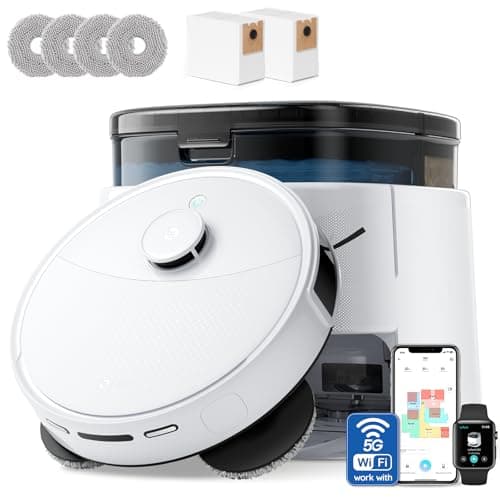
12,000Pa is a flagship-tier published figure at a sub-$250 price
A mop-washing dock at this price is genuinely unusual - most stop at self-emptying
Cool-air drying rather than heat, which is what stops a pad going stiff and smelling
Dual-band Wi-Fi, which sounds trivial until you own a mesh network that keeps handing it to the 5 GHz radio
What it gives up
A washing dock is plumbing. Two tanks, a tray and a pad to keep clean, and more to go wrong
Pa figures are not comparable between manufacturers - there is no shared test standard, and a big number is not automatically better cleaning
Still buying 3.2 L bags
The least established brand here for warranty and spare parts
Our scoring
Suction9.0
Navigation8.0
Pet hair7.0
Running cost6.0
Setup7.0
Weights and the arithmetic behind the total are published on How we pick so you can recompute this yourself.
Who it is for: A hard-floor home where mopping is the actual point and the dock has somewhere to live.
Skip it if: you want fewer chores rather than better ones. A self-washing dock removes the worst job and adds three small ones, and plenty of people would rather rinse a pad in the sink.
2.7 L bag, manufacturer states up to 70 daysSource: Manufacturer listing
Mopping
Sonic vibration mopping, up to 3,000 scrubs per minute, lifts up to 8 mm on carpetSource: Manufacturer listing
Carpet handling
Ultrasonic detection, raises the mop and increases suctionSource: Manufacturer listing
Anti-tangle
JawScrapers main brush plus anti-tangle side brushSource: Manufacturer listing
What it gets right
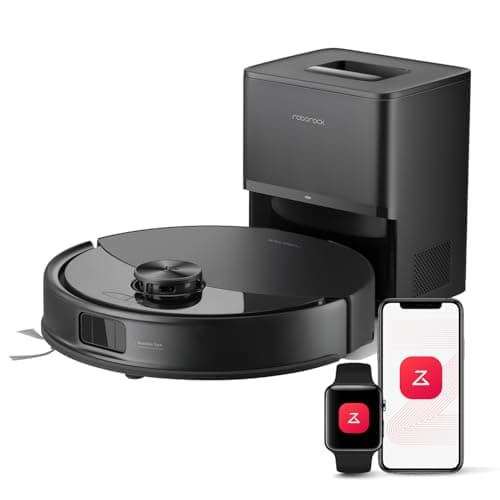
Structured-light obstacle avoidance is the single feature that separates a machine that finishes from one you rescue. Nothing else under $300 has it
A mop that lifts 8 mm means it can do hard floors and carpet in one run without wetting a rug
3,000 scrubs a minute is an actual scrubbing mechanism, not a damp pad
10,000Pa, dual anti-tangle brushes, multi-level maps - it gives up almost nothing to a $600 machine
What it gives up
The most expensive machine on this site, and it sits close to the ceiling
2.7 L bags are a recurring cost, and 70 days is mid-pack
The dock does not wash the mop - you rinse the pad yourself
2.4 GHz Wi-Fi only, which is an annoyance on a mesh network
Our scoring
Suction9.0
Navigation9.0
Pet hair8.5
Running cost6.5
Setup8.0
Weights and the arithmetic behind the total are published on How we pick so you can recompute this yourself.
Who it is for: A mixed-floor home with pets, clutter and rugs - the situation every other machine here handles by giving something up.
Skip it if: your floors are entirely hard and entirely tidy. Structured-light avoidance and an 8 mm mop lift are what you are paying the premium for, and a bare hard-floor flat uses neither.
#ad No live price for this one as of October 18, 2026. How we are funded
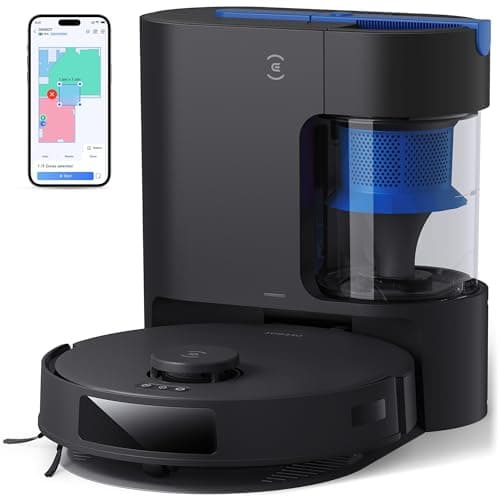
A self-emptying dock with no bag in it. Over three years that is the difference between this and everything else here, and it is not close.
Published specifications
Suction
8,000PaSource: Manufacturer listing
Navigation
TrueMapping laser radar, approximately 8-minute mapping runSource: Manufacturer listing
Self-emptying
Bagless dust container. Manufacturer states it saves up to $80 a year against bagsSource: Manufacturer listing
Anti-tangle
ZeroTangle main brushSource: Manufacturer listing
Filtration
PureCyclone with 4-stage filtration, 95% dust separation (manufacturer-reported)Source: Manufacturer listing
Battery / runtime
5,200 mAh, up to 200 minutes, up to 550 m2 per charge in silent or vacuum-only modeSource: Manufacturer listing
Threshold climbing
20 mmSource: Manufacturer listing
What it gets right
The dock has no consumable in it. Every other self-emptying machine here bills you every couple of months, forever
8,000Pa published, the second-highest figure under $250 here
ZeroTangle is a named mechanism for hair wrap rather than a vague claim
20 mm threshold climb clears door saddles that stop most of this field
What it gives up
A bagless bin means you see and smell what it collected, which the sealed-bag machines spare you
TrueMapping is competent but has no structured-light obstacle avoidance, so cables still catch it out
The 95% dust-separation figure is manufacturer-reported with no published test standard
The 550 m2 figure is for silent or vacuum-only mode, not for a normal mopping run
Our scoring
Suction8.5
Navigation7.5
Pet hair8.0
Running cost9.0
Setup7.5
Weights and the arithmetic behind the total are published on How we pick so you can recompute this yourself.
Who it is for: Someone doing the three-year arithmetic rather than looking only at the sticker price.
Skip it if: anyone in the house has a dust allergy. A bagless bin has to be tipped out, and that is exactly the moment a sealed bag exists to avoid.
Questions people actually ask
+−What does Pa suction mean on a robot vacuum?
Pascals measure the pressure differential the fan can generate, usually with the inlet sealed. It describes how hard the machine can pull, not how much dirt reaches the bin - airflow does that, and a sealed-inlet measurement removes airflow from the equation.
+−Is a higher Pa rating always better?
No. There is no shared test standard between manufacturers, so two brands' figures are different measurements sharing a unit. A large gap - 4,000 against 10,000 - is meaningful; a small one is noise. Above about 10,000Pa on a light machine, the limit becomes downforce rather than suction.
+−How much Pa suction do I need in a robot vacuum?
For hard floors, almost anything on the market is sufficient. For low-pile carpet with pets, 8,000Pa or more is a reasonable target, though automatic carpet boost matters more than the peak figure. Above 10,000Pa the returns diminish sharply.
+−Which robot vacuum has the highest Pa suction?
On this site, the Lefant M3 at 12,000Pa, followed by the Roborock machines at 10,000Pa. Remember that these figures come from different manufacturers using different methods, so the ranking is directional rather than precise.
+−Why do iRobot and Shark not publish a Pa figure?
Neither company explains it, and we will not speculate about motive. What is notable is that these are among the largest and longest-established manufacturers in floor care, and both have decided the figure is not worth quoting - which says something about how much weight the number deserves.
Sources
Every specification quoted above was read off one of these documents on the date shown. Where a manufacturer does not publish a figure, this site says "Not published" rather than estimating it.