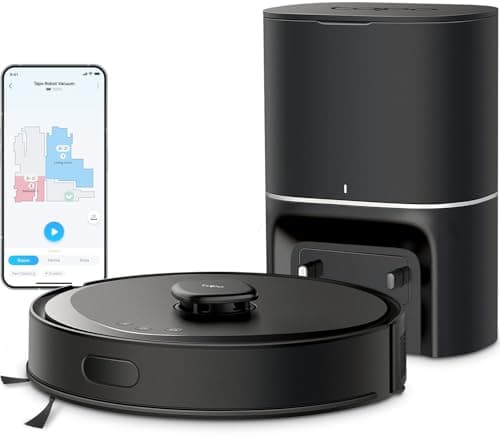
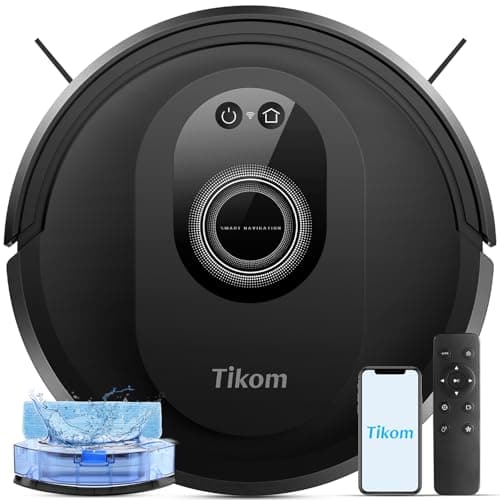
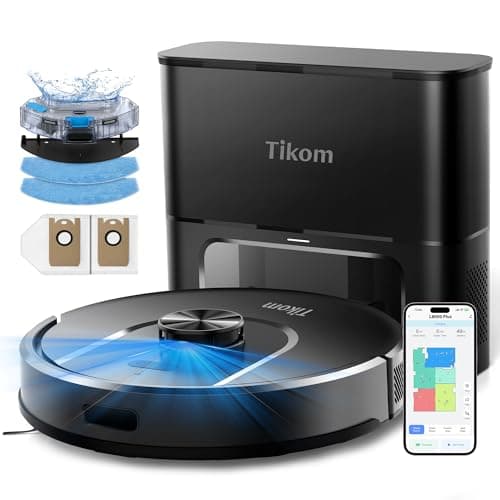
The two brands most responsible for self-emptying LiDAR costing under $220. One is TP-Link; the other you have probably never heard of.
By Scooter M., Enthusiast - published September 2, 2026
We have not tested these machines. Everything here comes from published specifications, manufacturer manuals and retailer listings, all cited below. Prices last verified October 18, 2026.
How this is funded: if you buy through a link here we may earn a commission, at no extra cost to you. It does not change which machines we recommend or what we say about them. Full disclosure.
Buy the Tikom L8000 Plus if you want the longest gap between bag changes - it publishes 90 days against Tapo's 60, plus 6,000Pa and five saved floor maps. Buy a Tapo if you would rather have a mainstream manufacturer behind the app, a slimmer body, and the cheapest self-emptying LiDAR machine anywhere.
These two brands are the reason self-emptying LiDAR now starts under $170 rather than at $400. Neither is a household name in vacuums; one is a household name in networking.
#
Product
Best for
Score
Price
01
Tikom L8000 PlusNinety days of hands-free running on a 3-liter bag, which is the longest emptying interval of anything here, at any price.
Both machines scored on the published rubric from How We Pick: suction 25%, navigation 25%, pet hair 20%, running cost 20%, setup 10%. Editorial judgments about published specifications, not test results.
Buy Tikom if
You want the longest dock interval on this site. 90 days on a 3-liter bag, against 60 for both Tapo docks. If the dock lives somewhere inconvenient, that is a real difference.
You have more than two floors. Five saved maps is the highest count here and unusual under $250.
You want higher published suction. 6,000Pa max with automatic carpet boost, against Tapo's 5,300Pa Ultra-mode peak.
You want separate no-mop zones, so a rug can be vacuumed but not wetted without banning the machine from the room.
Buy Tapo if
You want a self-emptying LiDAR machine from a mainstream brand. The RV30 Max Plus pairs the dock with inertial navigation that keeps the map square when a wheel slips.
Your furniture clearance is tight. 3.27 inches is slim for a machine with a LiDAR turret.
You want a mainstream company behind the app. Tapo is TP-Link's smart-home line - a large, established networking manufacturer rather than a small vacuum brand.
You want TP-Link behind the app. Tapo is a mainstream networking brand, and in a category where the app is half the product that is worth something Tikom cannot match.
Head to head
Every published figure, side by side
Tikom L8000 Plus
Tapo RV30 Max Plus
Published suction
6,000Pa max, auto carpet boost
5,300Pa Ultra mode
Navigation
360-degree LiDAR, 5 saved maps
LiDAR plus IMU
Dock
3 L bag, up to 90 days
3 L bag, up to 60 days
Runtime
Up to 150 min, recharge and resume
Not published
Zones
No-go, no-mop, virtual walls, rooms
Carpet zones set in app
Water settings
3 flow levels
3 flow levels
Height
Not published
Not published
Brand
Small specialist
TP-Link
All figures read from each manufacturer's own listing. Neither brand publishes a body height for these models.
The part of this comparison that is not a specification
Both machines are competent and closely matched on paper. The honest differentiator is what happens in three years, and that is not on either spec sheet.
A robot vacuum is a cloud-connected appliance with consumable parts. Two things have to keep existing for it to keep working: someone selling replacement brushes, filters and dock bags, and someone running the app server it pairs with. TP-Link is a large networking company with a broad smart-home line and a strong commercial reason to keep the Tapo platform running. Tikom is a small specialist with one product category.
We are not predicting that Tikom will disappear - we have no basis for that and it would be unfair. What we can say is that the asymmetry in risk is real, it is not reflected in either price, and it is worth knowing before you commit three years to one of them. It is also why brand appears as a row in the table above.
What neither of them does well
Neither states an anti-tangle brush design. For a household with long-haired pets, that is a meaningful gap, and at a similar price both Roborock and Ecovacs name a mechanism. If pets are your reason for buying, look at those instead.
Neither publishes a body height, which as the hardwood page explains is the specification most likely to make you regret a purchase.
Neither has obstacle avoidance. Both map with LiDAR and both are blind to anything lying on the floor.
3 suction levels, 3 water flow settingsSource: Manufacturer listing
What it gets right
Ninety days between bag changes is 50% longer than the Tapo docks and beats most flagships
Five saved maps handles a three-story house, which is unusual under $250
Separate no-mop zones, so you can keep it off a rug without banning it from the room
6,000Pa published, with automatic carpet boost
What it gives up
Bags are still a recurring cost, just a less frequent one
150 minutes is mid-pack, and a big home will need the resume feature to finish
A conventional main brush - no anti-tangle geometry is claimed
Tikom is a small brand; spare-part availability in three years is a genuine unknown
Our scoring
Suction8.0
Navigation8.0
Pet hair6.5
Running cost6.5
Setup7.5
Weights and the arithmetic behind the total are published on How we pick so you can recompute this yourself.
Who it is for: A multi-floor home where the dock is somewhere inconvenient and you want to visit it as rarely as possible.
Skip it if: you have long-haired pets. Nothing in this machine's published specification addresses hair wrap, and at a similar price the Roborock Q7 M5+ and the Ecovacs N20 Plus both name an anti-tangle mechanism.
5,000Pa published, which is more than several machines here costing twice as much
A 450 ml bin is large for this price - most sub-$150 machines fill up mid-run
Vacuums and mops in one pass rather than making you swap modules between runs
Four ways to control it, including a physical remote, which matters if the app is a fight
What it gives up
No mapping, so no no-go zones, no room selection and no resume-where-it-left-off
A conventional roller brush, so long hair does wrap and does need cutting out
The mop is a damp cloth dragged behind the machine, not a scrubbing head
No self-emptying, so the 450 ml bin is a job you do by hand
Our scoring
Suction7.0
Navigation3.5
Pet hair5.5
Running cost7.5
Setup8.0
Weights and the arithmetic behind the total are published on How we pick so you can recompute this yourself.
Who it is for: Hard floors, a tight budget, and someone who genuinely wants mopping rather than treating it as a bullet point.
Skip it if: you were hoping to draw no-go zones around a pet bowl or a cable nest. Without a map there is nothing to draw them on, and you will be putting up physical barriers instead.
Questions people actually ask
+−Is Tapo or Tikom better for a budget robot vacuum?
Tikom if you want the longest dock interval - 90 days against 60 - plus higher published suction and five saved floor maps. Tapo if you would rather have TP-Link, a large established manufacturer, behind the app and the long-term parts supply.
+−Is Tapo a good robot vacuum brand?
Tapo is TP-Link's smart-home line, so the company behind it is a large established networking manufacturer rather than a vacuum specialist. In practice that means the app is a mainstream product and the platform is unlikely to be abandoned, which is a real consideration for a cloud-connected appliance.
+−Is Tikom a reliable brand?
We have no reliability data and will not invent any. What we can say factually is that Tikom is a small specialist with one product category, which makes long-term parts and app support a larger unknown than with a big manufacturer. That risk is not reflected in the price either way.
+−Which has the longer-lasting dust bag?
Tikom, clearly. The L8000 Plus publishes up to 90 days on its 3-liter bag; both Tapo docks publish up to 60 days on the same 3-liter capacity. If your dock lives somewhere inconvenient, that is the most practical difference between the two brands.
+−Do either of these handle pet hair well?
Neither states an anti-tangle brush design, which is a real gap for a household with long-haired pets. At a similar price, Roborock and Ecovacs both name a specific mechanism, and those are the better choice if pets are the reason you are buying.
Sources
Every specification quoted above was read off one of these documents on the date shown. Where a manufacturer does not publish a figure, this site says "Not published" rather than estimating it.