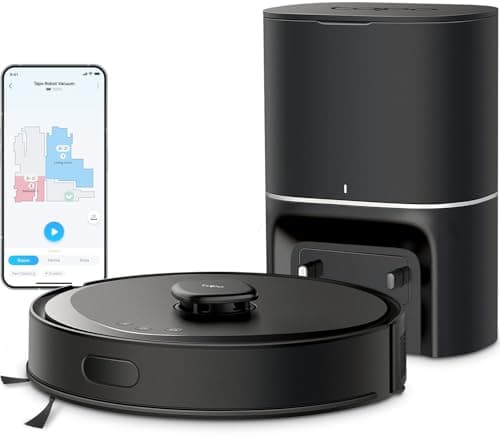
A self-emptying LiDAR machine from TP-Link for the price most brands charge for a bare mapping robot. The interesting part is the second navigation sensor.
By Scooter M., Enthusiast - published September 10, 2026
We have not tested these machines. Everything here comes from published specifications, manufacturer manuals and retailer listings, all cited below. Prices last verified September 21, 2026.
How this is funded: if you buy through a link here we may earn a commission, at no extra cost to you. It does not change which machines we recommend or what we say about them. Full disclosure.
The Tapo RV30 Max Plus is the best-navigating machine on this site under $200. It pairs LiDAR route planning with inertial measurement, empties itself into a 3-liter sealed bag TP-Link states lasts up to 60 days, and publishes up to 5,300Pa in Ultra mode with automatic carpet boost. What it does not publish is a runtime, a height, or a test method for its headline pickup figure.
#
Product
Best for
Score
Price
01
Tapo RV30 Max PlusTapo's better-navigating sibling with the same 3-liter self-emptying dock. If it is within $30 of the RV20 Max Plus, take this one.
#ad No live price for this one as of September 21, 2026. How we are funded
Scores come from the published rubric on How We Pick: suction 25%, navigation 25%, pet hair 20%, running cost 20%, setup 10%. Editorial judgments about published specifications, not test results.
What the specifications mean in a real home
LiDAR plus inertial measurement. This is the specification worth understanding, because it is the one nobody advertises well. LiDAR tells the machine where the walls are. An inertial measurement unit tracks the machine's own motion - so when a wheel slips on a rug edge or a threshold, the robot knows it moved differently from how it intended and can correct rather than drifting. Cheap mapping systems fail exactly there: the map slowly rotates out of alignment over a run, and the machine starts cleaning rooms that are no longer where it thinks they are.
Mesh Grid Technology. TP-Link's name for a grid-like cleaning pattern rather than simple back-and-forth rows. The claim is coverage without missed patches. It is a path-planning choice rather than new hardware, and it is the same idea Shark markets as Matrix Clean - see Shark vs Roomba for how that plays out at the top of the ceiling.
Up to 5,300Pa in Ultra mode. Note the wording: this is the peak in the loudest setting, not what it runs at by default. It sits mid-table on our published suction ranking, below the Lefant and Roborock figures and above the Tikom G8000 Max.
Carpet boost, plus carpet avoidance in mop mode. Both automatic. The machine raises suction when it detects low-pile carpet, and keeps the wet pad off carpeted areas when mopping - and you can mark rugs in the app rather than relying on detection alone. That second behavior is the one that matters, because a damp pad dragged onto a rug is the commonest failure in this whole category.
A 3-liter sealed bag, up to 60 days. Mid-pack. The Tikom L8000 Plus states 90 days on the same size of bag and the Ecovacs N20 Plus has no bag at all. Where it does win is that a sealed bag is the right answer for an allergy household - it comes out with the dust inside it, which is why this machine appears on our allergy ranking.
Over 97% dust pickup, DeepVac. A manufacturer-reported figure with no published test method attached, which is how we score it: as a claim, not as a measurement. TP-Link attributes it to an optimized air inlet, an improved brush and repositioned air ducts.
The brand is part of the specification here
Tapo is TP-Link's smart-home line, and TP-Link is a mainstream networking manufacturer rather than a robot vacuum startup. That matters in a category where the app is the product: the software is maintained alongside a much larger business, the account system already exists, and the company is not going to vanish in eighteen months.
It also shows up in the small things. Wi-Fi setup is the single most common first-day complaint across this whole category - our beginners ranking covers why - and it is the exact problem a networking company is best placed to have solved.
Who should buy it
Somebody who wants a self-emptying mapping machine and does not want to spend to the top of the ceiling. Under $200 the combination of LiDAR, an inertial sensor, a sealed dock and automatic carpet handling is not something the rest of this field offers, and the machines that beat it on paper cost meaningfully more.
It is also a sensible pick for a multi-room home with rugs, because the map staying accurate across a long run is exactly what the inertial sensor is for.
Who should not
Anyone who needs a slim body. TP-Link does not publish a height for this model, and it is not the ultra-slim one in the range - the RV20 Max Plus is, when it is in stock. If your sofa clearance is the constraint, this is the wrong Tapo.
Anyone counting the three-year cost. Sealed bags are a recurring expense that the bagless docks simply do not have. Our running costs guide puts numbers to it.
Anyone who wants real mopping. The pad is passive - dragged, with three flow settings, not driven. If mopping is the point, the machines with a published oscillation rate are a different category, and our is a robot mop worth it guide explains the difference.
Anyone with a heavily cluttered floor. LiDAR and an inertial sensor both work at turret height and above. Neither sees a cable lying flat.
Alternatives at this price
The Lefant N3 trades the dock for a genuine sonic mop and a longer published runtime. The Ecovacs DEEBOT N20 Plus costs more and removes the bag bill entirely while publishing 8,000Pa. And the under $200 band page ranks the whole shortlist with live prices.
What we did not verify
We have not handled this machine. Everything above is read from published specifications and the manufacturer's own documentation, cited below. These are the specific claims we could not check:
Runtime. TP-Link publishes no minute figure for this model, so we cannot tell you how much floor one charge covers.
Body height. Not stated, which matters because the slim body is the other machine in this range.
The 97% dust pickup figure. Manufacturer-reported with no published test method, and we ran no comparison.
Whether the 60-day bag interval holds with pets. Manufacturer intervals assume typical use; a shedding animal will shorten it.
How well the inertial sensor keeps the map square over a long run in a real home - no drift figure is published.
Noise. No decibel figure is published and we have not measured one.
Battery longevity. No cycle count is published, so year three is an unknown.
That list is not a disclaimer bolted on at the end. It is the actual scope of this review, and anywhere a competitor's confident phrasing implies they checked these things without saying how, it is worth asking the same question of them.
#ad No live price for this one as of September 21, 2026. How we are funded
Tapo's better-navigating sibling with the same 3-liter self-emptying dock. If it is within $30 of the RV20 Max Plus, take this one.
Published specifications
Suction
Up to 5,300Pa in Ultra modeSource: Manufacturer listing
Navigation
LiDAR with route planning; dual LiDAR and IMU navigation per the manufacturer's listingSource: Manufacturer listing
Self-emptying
3 L sealed disposable bag, typically up to 60 daysSource: Manufacturer listing
Carpet handling
Raises suction on low pile, avoids carpet in mop modeSource: Manufacturer listing
Dust pickup
Over 97% (manufacturer-reported, DeepVac)Source: Manufacturer listing
What it gets right
Adds inertial measurement to the LiDAR, which is what keeps a map straight when a wheel slips on a rug edge
Self-emptying at under $200, which almost nothing else manages
Same 5,300Pa and same automatic carpet handling as the rest of the Tapo line
Tapo is TP-Link, so the app is a mainstream product rather than a two-person side project
What it gives up
Not the ultra-slim body - it will not go under the furniture the RV20 clears
Same recurring 3 L bag cost
The 97% figure is again manufacturer-reported with no published method
The mop is a pad, not a scrubber
Our scoring
Suction7.5
Navigation8.5
Pet hair6.5
Running cost6.0
Setup8.0
Weights and the arithmetic behind the total are published on How we pick so you can recompute this yourself.
Who it is for: A multi-room home with rugs, where the map staying accurate matters more than the machine being slim.
Skip it if: you need the 3.27-inch profile. If your sofa clearance is the constraint, the RV20 Max Plus is the same idea in a body that fits.
Questions people actually ask
+−Is the Tapo RV30 Max Plus worth it?
Under $200 it is the best-navigating machine on this site - LiDAR plus an inertial sensor that keeps the map square when a wheel slips, with a 3-liter self-emptying bag rated at up to 60 days. It is not the pick if you need a slim body or want mopping that actually scrubs.
+−Does the Tapo RV30 Max Plus empty itself?
Yes, into a 3-liter sealed disposable bag that TP-Link states lasts up to 60 days. A sealed bag is also the better choice if anyone in the house reacts to dust, because it is removed with the dust inside it.
+−What is the suction of the Tapo RV30 Max Plus?
Up to 5,300Pa in Ultra mode - the peak in its loudest setting rather than its default. It also raises suction automatically when it detects low-pile carpet.
+−Does the Tapo RV30 Max Plus avoid carpet when mopping?
TP-Link states it avoids carpeted areas in mop mode and raises suction on low-pile carpet when vacuuming. You can also mark rugs in the Tapo app rather than relying on detection alone.
+−How is the RV30 Max Plus different from the RV20 Max Plus?
The RV20 is the ultra-slim body at 3.27 inches; the RV30 adds inertial measurement alongside the LiDAR, which is what keeps the map accurate when a wheel slips. Both use the same 3-liter sealed dock and the same 5,300Pa Ultra figure.
+−Have you tested the Tapo RV30 Max Plus?
No. This review is built from TP-Link's published specifications and its own listing, cited below, with an explicit list of the claims we could not check.
Sources
Every specification quoted above was read off one of these documents on the date shown. Where a manufacturer does not publish a figure, this site says "Not published" rather than estimating it.