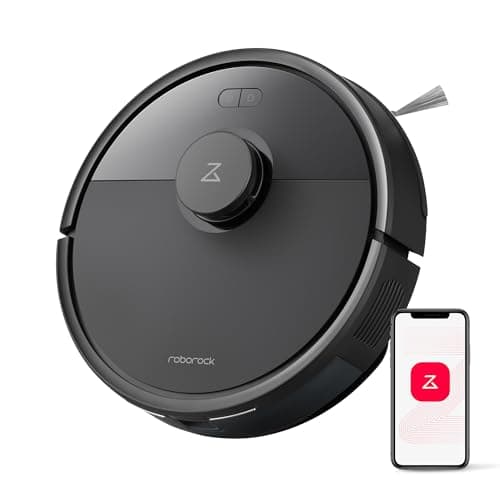
Roborock's own listing calls this an upgrade from the Q5 Pro, and it is the machine that slot now points to. It publishes more suction than anything else here that empties into its own bin, and it asks you to empty that bin yourself.
By Scooter M., Enthusiast - published October 6, 2026
We have not tested these machines. Everything here comes from published specifications, manufacturer manuals and retailer listings, all cited below. Prices last verified October 6, 2026.
How this is funded: if you buy through a link here we may earn a commission, at no extra cost to you. It does not change which machines we recommend or what we say about them. Full disclosure.
The Roborock Q7 L5 is the machine to buy if you want real mapping and real published suction without committing to a dock and its bags. Roborock states 8,000Pa, which is the highest published figure of any machine on this site that empties into its own bin, alongside 360-degree LiDAR with multi-level maps, two brushes designed against tangling, and vacuum-and-mop in a single pass from a 270 ml tank. What you give up is the dock, roughly an inch of height, and any mechanism that actually sees an obstacle.
#
Product
Best for
Score
Price
01
Roborock Q7 L58,000Pa and real LiDAR mapping with no dock to buy bags for. The highest published suction of any machine here that empties into its own bin.
Scores come from the published rubric on How We Pick: suction 25%, navigation 25%, pet hair 20%, running cost 20%, setup 10%. Editorial judgments about published specifications, not test results.
What the specifications actually say
Suction: 8,000Pa HyperForce. That figure matters twice. It is the highest published suction of any machine here that has no self-emptying dock, and below roughly the $150 mark nothing else on this site publishes more than 5,300Pa - the Tapo RV20 Max Plus holds that number. The two Roborocks with docks publish 10,000Pa, so this is not the strongest machine on the site; it is the strongest one you do not have to buy bags for. What a Pascal figure does and does not tell you is set out in what Pa suction actually means, and the whole published field is ranked on the highest published suction under $300.
Navigation: Precision LiDAR, a 360-degree scan, and multi-level maps. This is the real thing rather than a gyroscope dead-reckoning its way around a room. It means the machine cleans in planned rows instead of wandering, that keep-out zones work, that you can send it to one room, and that it holds a map per floor. Roborock states it saves multiple floor maps. Why that matters more in daily use than almost any other specification is argued in is LiDAR worth it, with the mechanisms separated in robot vacuum navigation, explained, and the cheapest mapping machines are collected on the cheapest robot vacuums with LiDAR mapping.
Two anti-tangle brushes, not one. Roborock specifies a main brush built against hair wrap plus a *zero-tangle side brush*. That second half is the part most anti-tangle claims quietly omit, and the side brush is where long hair actually winds itself into a solid collar. It is the same design argument as the dearer Roborock Q7 M5+, and the full field for shedding households is on best for pet hair.
Mopping: a 270 ml tank, three water levels, and one pass. It vacuums and mops at the same time rather than making you run the floor twice, and the pad is removable. Roborock also states something most listings bury, and it is worth repeating plainly: the water tank and the dustbin are a single integrated part. Carrying water therefore costs you dust capacity, which is a real constraint on a machine with no dock to empty into. Whether a budget robot mop is worth having at all is the question in is a robot mop worth it, and the combo field is on best budget robot vacuum and mop combos.
Runtime: 150 minutes. Roborock's published figure, and a generous one for this class - it is half an hour longer than the 120 minutes the cheapest machines here claim. With a map behind it, a long runtime is worth more than it sounds, because the machine spends that time covering floor in rows rather than re-crossing ground it has already done.
Height: 3.89 inches, on a 13.8-inch body. This is the specification that will decide the purchase for some people, and it is the machine's clearest weakness. The LiDAR turret sits on top, and 3.89 inches is nearly a full inch taller than the 2.99-inch machines at the bottom of this site's range. Published heights across the whole field are tabulated on best for low furniture. Measure before you buy.
App, voice, and 60 dB. The Roborock app covers suction levels, scheduling by time or by room, no-go zones and a child lock, and the machine answers to Alexa and Google Home. Roborock publishes a 60 dB noise figure, which is unusual - most manufacturers in this price range publish none. The app layer across the category is compared on robot vacuum apps and voice control. Note that it joins 2.4 GHz networks only, which on a mesh router usually means a few minutes of fiddling at setup.
What you are actually giving up
The dock. There is no self-emptying base - the included components are the robot, the mop module, a moisture-proof mat, a charging dock, an adapter and a manual. You empty the bin by hand, and in a shedding household that is a job every run or two rather than every two months. That is the entire trade this machine asks you to make, and the case for paying to avoid it is on is a self-emptying robot vacuum worth it.
Obstacle avoidance, which this machine does not have. Roborock's listing says it identifies areas like cables and table legs and *suggests no-go zones* for them. That is a map annotation you approve after the fact, not a sensor steering the machine around a sock in real time. The distinction gets blurred constantly at this price and it is worth being precise about, because the five different mechanisms that share the name are not equivalent - they are separated on what obstacle avoidance actually means at this price. If your floor is genuinely cluttered, this is the thing to spend on, and only the Q10 S5+ has it under $300.
A dustbin volume, which Roborock does not publish for this model. We score an unpublished figure as unverified rather than assuming the worst, but it does mean the one number you would want in order to judge how often you will be emptying it is simply absent from the listing.
There is also a small inconsistency in Roborock's own documentation that we are not going to smooth over: the feature bullets advertise three water levels, while the published specification table for the same ASIN states two power levels. Those are arguably different settings, but Roborock does not reconcile them anywhere on the listing, so we report both and claim neither.
How it sits against the other Roborocks here
This site ranks three Roborocks, and they divide cleanly. The Q10 S5+ is the overall pick under $300: 10,000Pa, a self-emptying dock, and the only structured-light obstacle avoidance in the price class. The Q7 M5+ is the pet-hair pick: the same 10,000Pa and dual anti-tangle brushes with a 2.7-liter dock, but no obstacle avoidance. Those two are compared directly on Roborock Q7 M5+ vs Q10 S5+.
The Q7 L5 is the third option and a genuinely different proposition rather than simply a cheaper one. It keeps the LiDAR mapping and the dual anti-tangle brushes, drops the dock entirely, and settles for 8,000Pa instead of 10,000. In exchange it is the cheapest of the three to own, because the recurring cost of the other two is a sealed bag you keep buying. If you were always going to empty a bin yourself, you are not giving up much here beyond a fifth of the suction figure.
What it costs to run
Close to nothing beyond electricity and consumable parts. The filter is washable, there is no dock, and there are no bags - which is why this machine scores well above both dock-equipped Roborocks on running cost under our published rubric. Over three years that gap is the most underrated number in this category, and we work the arithmetic through on what a robot vacuum actually costs to run. Roborock warrants the machine for one year against quality-related issues.
Who should buy it
Somebody with hard floors and rugs who wants the machine to actually know where it is, who wants a suction figure the manufacturer is willing to publish, and who would rather empty a bin than subscribe to bags. On that description this is the best-judged machine on the site, and it is the one we would point a first-time buyer at who has clear floors and no interest in a dock.
Do not buy it if you need to clean under a low sofa or a bed frame with less than four inches of clearance, or if your floors are cluttered enough that a machine needs to see and steer rather than be told where not to go. The first is a hard physical limit and the second is what the Q10 S5+ exists for. Everything the sub-$300 tier still makes you compromise on is listed on what you give up under $300.
What we did not verify
We have not handled this machine. Everything above is read from published specifications and the manufacturer's own documentation, cited below. These are the specific claims we could not check:
The 8,000Pa figure. It is Roborock's own published number and we have not measured suction on any machine.
The 150-minute runtime, and how far it falls on a floor with rugs, thresholds and a mopping pass in the same run.
How well the zero-tangle side brush resists long hair over months of real use, which is where anti-tangle claims usually come apart.
How much dust the integrated bin actually holds, because Roborock publishes no volume for it, and how much of that capacity the water tank takes up when you mop.
The 3.89-inch height and the 13.8-inch diameter. Both are published figures and we have not put a tape measure on the machine.
The 60 dB noise figure, measured at an unstated distance in unstated conditions.
How reliably the LiDAR holds a multi-floor map after furniture moves, which is the usual failure point of mapping at this price.
Whether the listing's three water levels and the specification table's two power levels describe the same control or two different ones.
That list is not a disclaimer bolted on at the end. It is the actual scope of this review, and anywhere a competitor's confident phrasing implies they checked these things without saying how, it is worth asking the same question of them.
8,000Pa is the highest published suction figure of any machine here without a self-emptying dock, and nothing under about $150 publishes more than 5,300Pa
Real LiDAR with multi-level maps, so keep-out zones and room-by-room cleaning both work
Both brushes are designed against tangling, and the side brush is where long hair actually wraps
No dock means no bags, ever. The filter is washable and there is nothing on subscription
Vacuums and mops in a single pass rather than making you run the floor twice
What it gives up
3.89 inches tall - the LiDAR turret puts it nearly an inch above the slimmest machines here, so low sofas and bed frames are out
You empty the bin yourself, and the tank and dustbin are a single integrated part, so mopping costs you dust capacity
Roborock publishes no dustbin volume for this model at all
It suggests no-go zones around cables rather than seeing and steering around objects - that is not obstacle avoidance
2.4 GHz Wi-Fi only, which is an annoyance on a mesh network
The listing advertises three water levels but the published specification table states two power levels, and Roborock does not reconcile the two
Our scoring
Suction8.0
Navigation8.5
Pet hair8.0
Running cost8.5
Setup8.0
Weights and the arithmetic behind the total are published on How we pick so you can recompute this yourself.
Who it is for: Somebody who wants mapping and real suction on hard floors and rugs, and would rather empty a bin than keep buying bags.
Skip it if: anything you need cleaned under sits lower than four inches. At 3.89 inches this machine is tall for the class, and no amount of suction helps with a floor it cannot reach.
Questions people actually ask
+−Is the Roborock Q7 L5 the same as the Q5 Pro?
No, but Roborock's own listing describes it as an upgrade from the Q5 Pro, and it is the machine that occupies that slot now. There is no plain Q5 or Q5 Pro selling new anywhere near this price - the only Q5-family listing we found with new stock was the Q5+, at more than twice this site's $300 ceiling.
+−Does the Roborock Q7 L5 have a self-emptying dock?
No. The included components are the robot, the mop module, a moisture-proof mat, a charging dock, an adapter and a manual. You empty the bin by hand, which is also why it has no bags to buy and the lowest running cost of the three Roborocks we rank.
+−How much suction does the Roborock Q7 L5 have?
Roborock publishes 8,000Pa in HyperForce mode. That is the highest published figure of any machine on this site without a self-emptying dock, and below about $150 nothing else here publishes more than 5,300Pa. The two Roborocks with docks publish 10,000Pa.
+−Does the Roborock Q7 L5 avoid obstacles?
Not in the way that phrase implies. Roborock says it identifies things like cables and table legs and suggests no-go zones for them, which is a map annotation rather than a sensor steering around an object in real time. For genuine structured-light avoidance under $300 the Q10 S5+ is the only option we rank.
+−Will the Roborock Q7 L5 fit under my furniture?
Only if you have more than about four inches of clearance. Roborock publishes 3.89 inches, which is nearly an inch taller than the slimmest machines we rank, because the LiDAR turret sits on top of the body. Measure the gap before buying.
+−Does the Roborock Q7 L5 mop and vacuum at the same time?
Yes. It carries a 270 ml tank with three water levels and a removable pad, and it vacuums and mops in a single pass. Be aware that Roborock designs the water tank and the dustbin as one integrated part, so filling the tank reduces the dust capacity on that run.
Sources
Every specification quoted above was read off one of these documents on the date shown. Where a manufacturer does not publish a figure, this site says "Not published" rather than estimating it.
Availability and price check, 2026-10-06Listing read and confirmed in stock with a new-condition offer on the day of publication, and the ASIN resolved through the Amazon Creators API with the title matching brand and model. Every specification above is quoted from that listing or from its published specification table; nothing is carried across from the Q5 Pro this machine replaces.