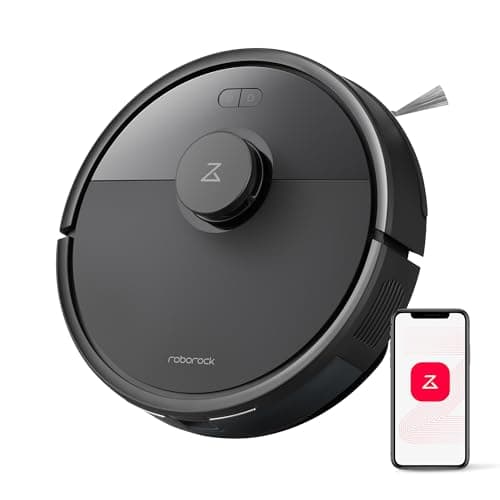
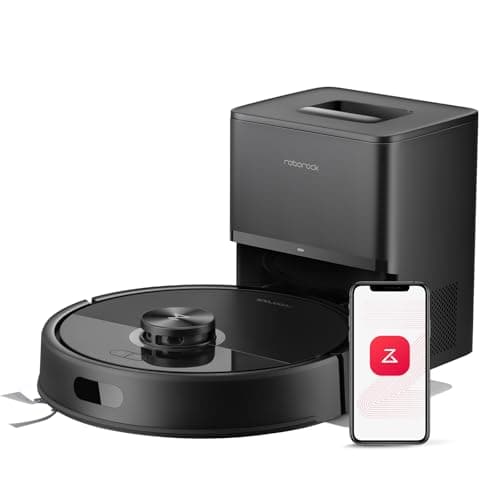
Two machines from the same range with the same brush design and the same scoring on our rubric. One empties itself and one does not, and that single difference is almost the whole decision.
By Scooter M., Enthusiast - published November 14, 2026
We have not tested these machines. Everything here comes from published specifications, manufacturer manuals and retailer listings, all cited below. Prices last verified November 22, 2026.
How this is funded: if you buy through a link here we may earn a commission, at no extra cost to you. It does not change which machines we recommend or what we say about them. Full disclosure.
If emptying the bin is the chore you are trying to remove: buy the Roborock Q7 M5+. Its sealed 2.7-liter bag is stated at seven to nine weeks, and it publishes 10,000Pa against the other machine's 8,000Pa. If you would rather empty a bin than buy bags forever, or you have more than one floor: buy the Roborock Q7 L5. It costs less, it has no consumable at all, and it is the one of the two that states multi-level maps. On hair they are a tie - both name an anti-tangle main brush and an anti-tangle side brush, which is the specification this site rates most highly and which almost nothing else at this price states for both.
This is the cleanest version of the question this site gets asked more than any other: is a self-emptying dock worth paying for? Most comparisons that try to answer it are comparing machines that differ in six ways at once. These two differ in essentially one, from one manufacturer, within one product line - so for once the dock premium can be looked at on its own.
#
Product
Best for
Score
Price
01
Roborock Q7 M5+10,000Pa, a self-emptying dock, and the only anti-tangle system here that treats the side brush as part of the problem.
Roborock Q7 L58,000Pa and real LiDAR mapping with no dock to buy bags for. The highest published suction of any machine here that empties into its own bin.
Both machines scored on the published rubric from How We Pick: suction 25%, navigation 25%, pet hair 20%, running cost 20%, setup 10%. Editorial judgments about published specifications, not test results.
Our own rubric scores them identically, and that is the finding
Both machines come out at 8.2 overall on the published weights set out on how we pick. They get there by opposite routes: the Q7 M5+ scores higher on suction and pet hair, the Q7 L5 scores higher on running cost, and they are level on navigation and setup. Neither is the better machine. They are the same machine aimed at two different problems, and the rest of this page is about working out which problem is yours.
What is genuinely identical
The brush design, which is the part that matters most in a shedding household. Both state an anti-tangle main brush and an anti-tangle side brush - the Q7 M5+ names JawScrapers and a 0% hair-tangling side brush, the Q7 L5 states a main brush plus a zero-tangle side brush. The side brush is where long hair wraps worst and almost no manufacturer mentions it, which is why the anti-tangle ranking puts Roborock at the top. If hair is the only reason you are looking at the dearer machine, you do not need the dearer machine.
LiDAR mapping on both, with app zones and room selection. Mopping in the same pass as vacuuming on both, with three water settings each. No structured-light obstacle avoidance on either - that is the Q10 S5+'s feature and it is the one real reason to go further up the range, which the Q7 L5 against the Q10 S5+ covers. And 2.4 GHz Wi-Fi only on both, which is the same setup annoyance on a mesh router.
Specification by specification
Read from both Roborock listings on the day of publication
Specification
Roborock Q7 M5+
Roborock Q7 L5
What it means here
Self-emptying
2.7 L sealed bag, stated 7 to 9 weeks
None - charging dock only
The entire reason for the price difference
Suction
10,000Pa HyperForce
8,000Pa HyperForce
Same family, same scale - this is one of the few cross-model Pa comparisons that is fair
Anti-tangle
JawScrapers main brush plus a stated 0% hair-tangling side brush
Dual - a main brush plus a stated zero-tangle side brush
Only the cheaper machine states more than one saved floor
Runtime
Not published
150 minutes
Only the cheaper machine publishes a figure
Noise
Not published
60 dB
Only the cheaper machine publishes a figure
Height and diameter
Not published
3.89 in tall, 13.8 in diameter
Only the cheaper machine lets you check it against your sofa
Warranty
Not published on the listing
1 year, quality-related issues
Only the cheaper machine states one
Running cost
Sealed bags, forever
Washable filter, no consumable in the dock
The dock premium is paid once and then monthly
Where a manufacturer does not publish something it is recorded as not published rather than estimated or carried across from the sibling model - which on two machines in the same range is a tempting shortcut and still not one we take.
What the dock actually buys, and what it costs
It buys you about two months of not thinking about the machine. Roborock states seven to nine weeks on a 2.7-liter sealed bag. Against emptying a 300 to 550 ml onboard bin roughly twice a week in a shedding home, that is the difference between a chore and an appliance - and it is a real difference, not a marketing one.
It costs you a bag bill that never ends. A sealed bag is a consumable, so at the stated interval you are buying roughly six to seven bags a year for as long as you own the machine. The Q7 L5 has no dock consumable at all - the filter is washable and there is nothing on subscription. Our running costs guide works the three-year arithmetic through, and the short version is that the dock premium is paid once at the till and then again, quietly, every couple of months.
And it costs you floor space. A self-emptying station is roughly the size of a small kitchen bin, it needs clearance on three sides so the robot can dock accurately, and it needs a socket it occupies permanently. In a house that is a corner of a hallway. In a small flat it is a visible piece of your living space, which is why best for apartments leans the other way and why best for renters argues against a dock outright when the lease has an end date.
The general version of this trade, across every dock machine we rank, is on is a self-emptying robot vacuum worth it. The honest summary is that it is worth it in a shedding household with floor space, and close to pointless in a tidy one-bedroom flat.
The suction gap is real but it is the smaller story
10,000Pa against 8,000Pa is a 25% difference on paper, and unusually for this site it is a fair comparison: Pascal figures have no shared test standard across brands, but these two numbers come from the same manufacturer using the same HyperForce naming within the same product range. The caveat this site normally attaches does not apply with the same force here - the argument in full is on what Pa suction actually means.
What keeps it the smaller story is that both machines have the same brushes. On carpet, agitation and brush design do more work than the last 2,000Pa, and on hard floors neither figure is the constraint - hair and dust lift off a sealed floor with very little airflow. The suction gap is worth something on medium-pile carpet with heavy soiling. It is worth very little on a hard-floor home, which is most of this site's readers.
The multi-floor line nobody notices
This is the most easily missed row in the table and it points the opposite way to the price. Roborock states multi-level maps for the Q7 L5 and states only real-time mapping for the Q7 M5+. We report what each listing says rather than assuming the feature carries across a product line, so on published specifications the cheaper machine is the one documented to hold more than one floor plan.
If you have stairs, check that before you spend the extra - and note that the dock complicates a two-story home anyway, because the station lives on one floor and the robot has to be carried to the other. Best for a two-story house ranks on exactly this problem.
Which one we would buy
A shedding household with somewhere to put a station: the Q7 M5+. Volume is the problem a dock solves and nothing else does. Hair wrap is already solved on both machines, so you are paying specifically for the bin, and in a house with a molting dog that is money well spent.
A hard-floor home, a flat, a rented place, or more than one floor: the Q7 L5. It costs less, it has no consumable, it publishes more, it states the multi-floor map, and it gives up a suction figure that matters least exactly where most readers live. If the bin becomes a chore later, that is a reason to buy a dock machine later - not a reason to pay for one now.
Either way, buy within the Roborock Q7 line rather than away from it if hair is your problem, because the both-brushes claim is the thing neither of these gives up and almost nothing else in this price range states at all.
What we did not verify
We have not handled either machine and nothing here is a test result. Every figure is quoted from the two Roborock listings and cited below: the Q7 M5+'s 10,000Pa, PreciSense LiDAR, 2.7-liter sealed bag with a stated seven-to-nine-week interval, JawScrapers main brush and 0% hair-tangling side brush; and the Q7 L5's 8,000Pa, precision LiDAR with multi-level maps, dual anti-tangle brushes, 270 ml tank with a removable pad, 150-minute runtime, 60 dB figure, 3.89-inch height and one-year warranty. We have not measured suction on either, timed a dock interval in a real home, confirmed that a stated zero-tangle side brush stays clear, or established whether the Q7 M5+ in fact holds multiple floor plans - Roborock does not state that it does, which is not the same as it being absent, and we record it as unstated rather than missing. Neither listing publishes a dustbin volume. The Q7 M5+ publishes no runtime, noise figure, height or warranty, so those four lines are scored as unverified rather than poor.
10,000Pa, a self-emptying dock, and the only anti-tangle system here that treats the side brush as part of the problem.
Published specifications
Suction
10,000Pa HyperForceSource: Manufacturer listing
Navigation
PreciSense LiDAR with real-time mappingSource: Manufacturer listing
Self-emptying
2.7 L sealed bag, manufacturer states 7 to 9 weeksSource: Manufacturer listing
Anti-tangle
JawScrapers main brush plus a stated 0% hair-tangling side brushSource: Manufacturer listing
Mopping
Vacuum and mop in one pass, 3 water flow settingsSource: Manufacturer listing
What it gets right
Both brushes are designed against tangling. Every other anti-tangle claim here covers only the main brush, and the side brush is where long hair actually wraps
10,000Pa published, matching machines at three times the price
Roborock's app is the most capable in this group after iRobot's, and its maps survive furniture moves
Vacuums and mops in a single pass rather than two runs
What it gives up
2.7 L and 7 to 9 weeks is a shorter interval than the Tikom L8000 Plus manages
No structured-light obstacle avoidance at this price - that is the Q10's feature
Sealed bags are a recurring cost
The mop still cannot be washed by the dock
Our scoring
Suction9.0
Navigation8.5
Pet hair8.5
Running cost6.5
Setup8.0
Weights and the arithmetic behind the total are published on How we pick so you can recompute this yourself.
Who it is for: A shedding dog or a long-haired cat, on any floor type.
Skip it if: your home is cluttered at floor level. LiDAR maps walls, not socks and charging cables, and without obstacle avoidance this machine will eventually eat one.
8,000Pa is the highest published suction figure of any machine here without a self-emptying dock, and nothing under about $150 publishes more than 5,300Pa
Real LiDAR with multi-level maps, so keep-out zones and room-by-room cleaning both work
Both brushes are designed against tangling, and the side brush is where long hair actually wraps
No dock means no bags, ever. The filter is washable and there is nothing on subscription
Vacuums and mops in a single pass rather than making you run the floor twice
What it gives up
3.89 inches tall - the LiDAR turret puts it nearly an inch above the slimmest machines here, so low sofas and bed frames are out
You empty the bin yourself, and the tank and dustbin are a single integrated part, so mopping costs you dust capacity
Roborock publishes no dustbin volume for this model at all
It suggests no-go zones around cables rather than seeing and steering around objects - that is not obstacle avoidance
2.4 GHz Wi-Fi only, which is an annoyance on a mesh network
The listing advertises three water levels but the published specification table states two power levels, and Roborock does not reconcile the two
Our scoring
Suction8.0
Navigation8.5
Pet hair8.0
Running cost8.5
Setup8.0
Weights and the arithmetic behind the total are published on How we pick so you can recompute this yourself.
Who it is for: Somebody who wants mapping and real suction on hard floors and rugs, and would rather empty a bin than keep buying bags.
Skip it if: anything you need cleaned under sits lower than four inches. At 3.89 inches this machine is tall for the class, and no amount of suction helps with a floor it cannot reach.
Questions people actually ask
+−Is the Roborock Q7 M5+ worth the extra over the Q7 L5?
It depends entirely on whether emptying a bin is a problem in your house. The dock is almost the whole difference: both machines share the same anti-tangle main and side brushes, both map with LiDAR and both mop in the same pass. In a shedding household with floor space for a station, the dock is worth it - it is stated at seven to nine weeks against emptying an onboard bin about twice a week. In a tidy flat, or if you would rather not buy bags forever, the cheaper machine does the same cleaning.
+−Which one is better for pet hair?
On hair wrap they are a tie, and that is the useful answer. Both state an anti-tangle main brush and an anti-tangle side brush, which is the specification that decides a shedding household and which almost nothing else at this price states for both brushes. Where the Q7 M5+ pulls ahead is volume rather than wrap: a shedding dog fills an onboard bin in a couple of runs, and the sealed dock turns that from a twice-weekly job into something you do every couple of months.
+−Does the Q7 L5 have a self-emptying dock?
No. It ships a charging dock only, so the onboard bin is yours to empty. That is also why it has no dock consumable - the filter is washable and there are no sealed bags to buy, which over three years is a real saving against the Q7 M5+.
+−Is 10,000Pa noticeably better than 8,000Pa?
On medium-pile carpet with heavy soiling, possibly. On hard floors, very little - dust and hair lift off a sealed surface with almost no airflow, and brush design does more work than the last 2,000Pa anyway. This is one of the rare fair Pascal comparisons because both figures come from the same manufacturer within the same range, but it is still the smaller of the two differences on this page.
+−Which one works better on two floors?
On published specifications, the Q7 L5 - Roborock states multi-level maps for it and states only real-time mapping for the Q7 M5+. We report what each listing says rather than assuming a feature carries across a product line, so check it before you spend the extra. A dock also complicates a two-story home in a way the specification sheet does not show, because the station lives on one floor and the robot has to be carried to the other.
+−Do either of them avoid obstacles on the floor?
Neither has structured-light obstacle avoidance. Both navigate with LiDAR, which maps walls and furniture at turret height and is blind to a sock, a charging cable or a toy lying flat. If your floors are cluttered, that sensor is the reason to look at the Roborock Q10 S5+ instead of either machine here.
Sources
Every specification quoted above was read off one of these documents on the date shown. Where a manufacturer does not publish a figure, this site says "Not published" rather than estimating it.
Availability and price check, 2026-11-14Both ASINs were resolved through the Amazon Creators API on the day of publication and each returned a New-condition buy-box offer with IN_STOCK availability and a catalog image. The raw offer payload was read directly rather than the normalized helper, because that helper reports a default value when a listing carries no availability object.