For a shedding household, yes, and it is the single biggest quality-of-life feature in this price range. For a small tidy flat it is money spent on a bigger box in your hallway.
By Scooter M., Enthusiast - published September 10, 2026
We have not tested these machines. Everything here comes from published specifications, manufacturer manuals and retailer listings, all cited below. Prices last verified September 21, 2026.
How this is funded: if you buy through a link here we may earn a commission, at no extra cost to you. It does not change which machines we recommend or what we say about them. Full disclosure.
A self-emptying dock is worth it if you have a pet, a large floor plan, or an allergy - it turns emptying a small bin roughly twice a week into changing a bag every two or three months, which is the difference between a machine you keep using and one that ends up in a cupboard. It is not worth it in a small, tidy, pet-free home, where you are paying for a bigger dock, an ongoing bag bill and floor space you may not have.
That is the short answer. The useful part is the arithmetic, because the numbers are more lopsided than most people expect.
The arithmetic, done properly
Start with the bin. Robot vacuum bins in this price range hold roughly 400 to 550 ml. That sounds like a lot until you remember it is the volume of a large mug. With a shedding dog, owners typically empty it every second or third run; with a scheduled daily clean, that is somewhere around 100 to 150 emptying events a year.
Now the dock. The published intervals on this site run from 60 days to 90 days. Call it four to six events a year. That is the entire proposition: roughly 100-plus small unpleasant jobs replaced by roughly five.
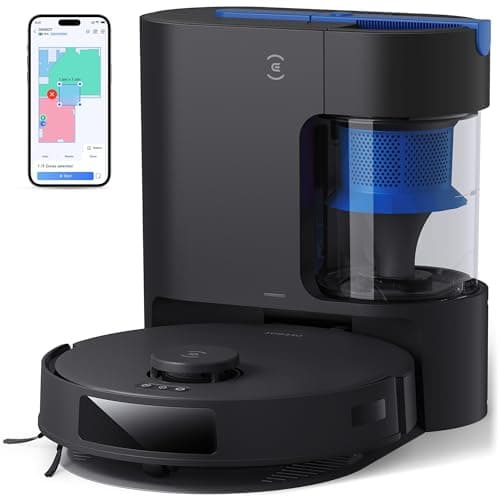
Then the cost. A bagged dock takes a sealed bag each time, so four to six bags a year, at a few dollars each, forever. A bagless dock - the Ecovacs DEEBOT N20 Plus and the Shark Matrix Plus here - has no consumable at all, and Ecovacs states its bagless station saves up to $80 a year against bags. Our running costs guide works that through across the whole field.
#
Product
Best for
Score
Price
01
Ecovacs DEEBOT N20 PlusA self-emptying dock with no bag in it. Over three years that is the difference between this and everything else here, and it is not close.
#ad No live price for this one as of September 21, 2026. How we are funded
04
iRobot Roomba 105 Vac with AutoEmpty DockThe 105 Vac plus a sealed-bag dock that traps particles down to 0.7 microns. The only machine here that publishes a filtration figure that small.
If the answer for your home is yes, these are the four docks we would buy, ranked by what they cost to keep running. Scores from the published rubric on How We Pick.
The three homes where it is genuinely worth it
1. Any home with a shedding animal. Hair is bulky and arrives continuously, so the bin fills faster than dust ever would. This is the case where the dock stops being a convenience and becomes the thing that keeps the machine in service. It is also why our pet hair ranking is dominated by docked machines.
2. A large floor plan. More square footage means more debris per run and a longer walk to the machine. Both push in the same direction - see the large house ranking.
3. An allergy household - but only with a sealed bag. A sealed bag is removed with the dust inside it, so the emptying cloud never happens. A bagless base still has to be tipped out. That distinction is the whole of our allergy ranking, and it inverts the usual advice: the cheaper-to-run option is the wrong one for this buyer.
The two homes where it is not
A small, tidy, pet-free flat. If the bin needs emptying once a week and the machine lives ten steps away, you are buying a larger dock to solve a job that takes fifteen seconds. Put the money into mapping or suction instead. A Roomba 105 Vac or a Lefant N3 gives you the map without the base.
A home with nowhere to put it. This is underrated and it is the complaint people actually have. A self-emptying base is a piece of furniture: it needs clear floor either side to dock reliably, it wants to be near a socket, and a bagless base is physically larger than a bagged one because the cyclone has to live somewhere. In a small hallway that is a real cost.
The three ways to deal with a full bin
No dock
Bagged dock
Bagless dock
Hands-on events per year
Roughly 100 to 150
4 to 6 bag changes
4 to 6 bin empties
Ongoing cost
None
Bags, forever
None
Dust exposure when emptying
Every time
Sealed - none
Every empty
Floor space
Charging pad only
Full base
Largest base
Best for
Small tidy homes
Allergy households
Everyone else
Emptying frequencies are derived from published bin volumes and dock intervals on this site, not measured. Your own frequency depends on floor area, pets and how often you run it.
What a dock does not do
It does not clean the brush. Hair still wraps, and clearing it is still a job you do by hand every couple of weeks. Only one machine on this site publishes a self-cleaning brushroll, and it is the Shark Matrix Plus.
It does not wash the mop pad. With one exception - the Lefant M3 and its 45C wash - a dock empties the bin and stops. A dirty pad still goes back on the floor next run unless you rinse it.
It does not make the machine clean better. Nothing about a dock improves suction, navigation or coverage. It changes how often you think about the machine, which is worth a great deal, and it is not a cleaning upgrade.
It is not silent. The emptying cycle is loud - louder than the machine cleaning - for several seconds after every run. Do not put the base outside a bedroom door and schedule a 6am clean.
Bagged or bagless, if you have decided yes
Bagless if you are optimizing money, and it is not close: no consumable, ever. Over three years, on a machine you keep, that gap is a meaningful fraction of the purchase price.
Bagged if anyone in the house reacts to dust, because the sealed bag means the collected dust is never opened in your kitchen. iRobot states its AutoEmpty bag traps 99% of allergens as small as 0.7 microns; that claim only pays off because the bag is removed intact.
Look at the stated interval, then shorten it in your head. Manufacturer intervals - 60 days, 75 days, 90 days - assume an average home. A shedding dog and a big floor plan will both compress them, and nobody publishes a figure for what they compress to.
What we could not verify
We have not handled these machines, timed an emptying cycle or measured what a bagless base releases when it is tipped out - nobody publishes that figure. The emptying-frequency arithmetic above is derived from published bin volumes and published dock intervals, and it is arithmetic rather than a measurement: your own numbers depend on your floors, your pets and your schedule. Every dock interval and filtration figure quoted is the manufacturer's own, cited below.
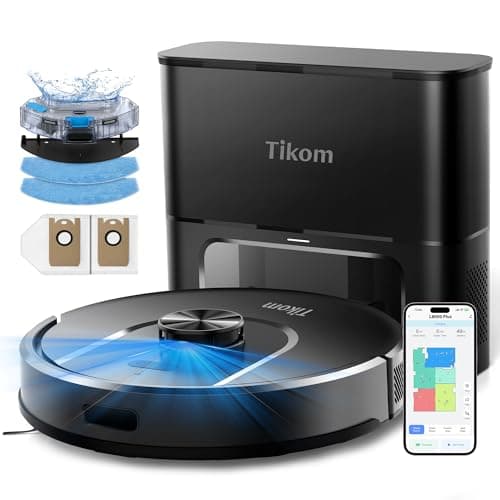
3 suction levels, 3 water flow settingsSource: Manufacturer listing
What it gets right
Ninety days between bag changes is 50% longer than the Tapo docks and beats most flagships
Five saved maps handles a three-story house, which is unusual under $250
Separate no-mop zones, so you can keep it off a rug without banning it from the room
6,000Pa published, with automatic carpet boost
What it gives up
Bags are still a recurring cost, just a less frequent one
150 minutes is mid-pack, and a big home will need the resume feature to finish
A conventional main brush - no anti-tangle geometry is claimed
Tikom is a small brand; spare-part availability in three years is a genuine unknown
Our scoring
Suction8.0
Navigation8.0
Pet hair6.5
Running cost6.5
Setup7.5
Weights and the arithmetic behind the total are published on How we pick so you can recompute this yourself.
Who it is for: A multi-floor home where the dock is somewhere inconvenient and you want to visit it as rarely as possible.
Skip it if: you have long-haired pets. Nothing in this machine's published specification addresses hair wrap, and at a similar price the Roborock Q7 M5+ and the Ecovacs N20 Plus both name an anti-tangle mechanism.
#ad No live price for this one as of September 21, 2026. How we are funded
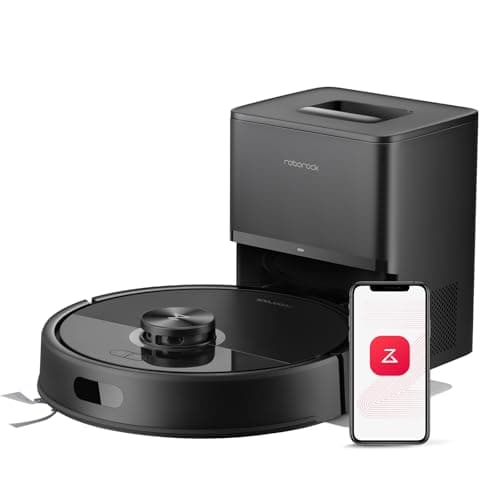
10,000Pa, a self-emptying dock, and the only anti-tangle system here that treats the side brush as part of the problem.
Published specifications
Suction
10,000Pa HyperForceSource: Manufacturer listing
Navigation
PreciSense LiDAR with real-time mappingSource: Manufacturer listing
Self-emptying
2.7 L sealed bag, manufacturer states 7 to 9 weeksSource: Manufacturer listing
Anti-tangle
JawScrapers main brush plus a stated 0% hair-tangling side brushSource: Manufacturer listing
Mopping
Vacuum and mop in one pass, 3 water flow settingsSource: Manufacturer listing
What it gets right
Both brushes are designed against tangling. Every other anti-tangle claim here covers only the main brush, and the side brush is where long hair actually wraps
10,000Pa published, matching machines at three times the price
Roborock's app is the most capable in this group after iRobot's, and its maps survive furniture moves
Vacuums and mops in a single pass rather than two runs
What it gives up
2.7 L and 7 to 9 weeks is a shorter interval than the Tikom L8000 Plus manages
No structured-light obstacle avoidance at this price - that is the Q10's feature
Sealed bags are a recurring cost
The mop still cannot be washed by the dock
Our scoring
Suction9.0
Navigation8.5
Pet hair8.5
Running cost6.5
Setup8.0
Weights and the arithmetic behind the total are published on How we pick so you can recompute this yourself.
Who it is for: A shedding dog or a long-haired cat, on any floor type.
Skip it if: your home is cluttered at floor level. LiDAR maps walls, not socks and charging cables, and without obstacle avoidance this machine will eventually eat one.
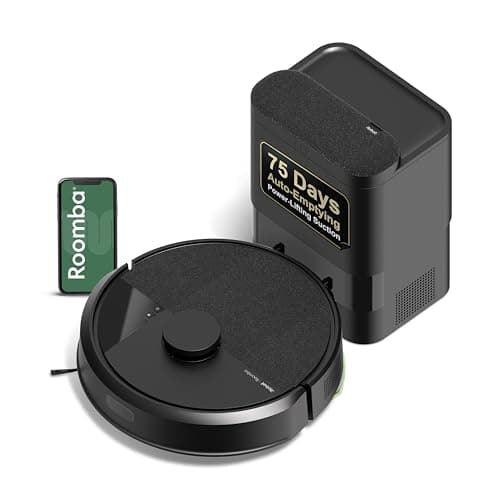
The 105 Vac plus a sealed-bag dock that traps particles down to 0.7 microns. The only machine here that publishes a filtration figure that small.
Published specifications
Suction
Not published as PaSource: Manufacturer listing
Navigation
ClearView LiDAR mapping with keep-out zonesSource: Manufacturer listing
Self-emptying
AutoEmpty dock, manufacturer states up to 75 daysSource: Manufacturer listing
Dock filtration
Bag traps 99% of allergens as small as 0.7 microns (manufacturer-reported)Source: Manufacturer listing
Recharge and resume
YesSource: Manufacturer listing
What it gets right
0.7 microns is a finer published figure than the 'HEPA-style' language most of this field uses
A sealed bag means emptying never releases a dust cloud, which is the whole point for an allergy household
75 days between bag changes
Mature LiDAR mapping and the best app here
What it gives up
Still no published suction rating
iRobot dock bags cost more than the generic-brand equivalents
Vacuum only - no mop
About $100 more than the same robot without the dock
Our scoring
Suction6.0
Navigation8.0
Pet hair6.5
Running cost6.0
Setup8.5
Weights and the arithmetic behind the total are published on How we pick so you can recompute this yourself.
Who it is for: A household where somebody reacts to dust, and emptying a bin by hand is the problem rather than the chore.
Skip it if: nobody in the house has allergies. Without that, the sealed bag is the more expensive way to do what the Ecovacs N20 Plus does with no consumable at all.
Questions people actually ask
+−Is a self-emptying robot vacuum worth it?
For a home with a pet, a large floor plan or an allergy, yes - it replaces roughly 100 to 150 bin emptyings a year with four to six bag changes. For a small tidy pet-free flat it is usually not worth the money, the bags or the floor space.
+−How often do you empty a self-emptying robot vacuum?
The published intervals on this site run from 60 to 90 days, so four to six times a year. Those are manufacturer figures for an average home - a shedding pet or a large floor plan will shorten them.
+−Are self-emptying docks expensive to run?
A bagged dock takes four to six sealed bags a year at a few dollars each, forever. A bagless dock has no consumable at all - Ecovacs states its bagless station saves up to $80 a year against bags.
+−Is a bagless dock better than a bagged one?
For running cost, clearly - there is nothing to buy. For an allergy household, no: a bagless base has to be tipped out, which is the moment fine dust goes back into the room, while a sealed bag is removed with the dust inside it.
+−Do self-emptying docks empty the mop water too?
No. A dock empties the dustbin. The water tank and the mop pad are yours to deal with, with one exception on this site: the Lefant M3, whose dock washes the pad in 45C water and dries it with cool air.
+−Are self-emptying docks noisy?
The emptying cycle is loud for a few seconds after each run - noticeably louder than the machine cleaning. It is worth thinking about where the base lives before you schedule an early-morning clean.
Sources
Every specification quoted above was read off one of these documents on the date shown. Where a manufacturer does not publish a figure, this site says "Not published" rather than estimating it.