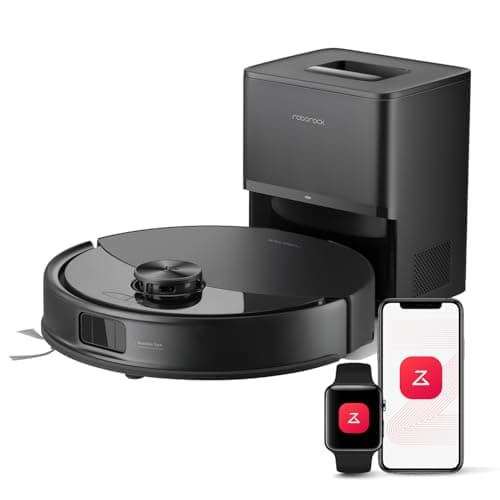
The site's overall pick, and it wins on one sensor nothing else under $300 has. Here is the full specification and the limits of what we can tell you.
By Scooter M., Enthusiast - published September 2, 2026
We have not tested these machines. Everything here comes from published specifications, manufacturer manuals and retailer listings, all cited below. Prices last verified October 17, 2026.
How this is funded: if you buy through a link here we may earn a commission, at no extra cost to you. It does not change which machines we recommend or what we say about them. Full disclosure.
The Roborock Q10 S5+ is the best robot vacuum under $300 because it is the only one at this price that pairs LiDAR mapping with ReactiveTech structured-light obstacle avoidance. LiDAR maps your walls; structured light sees the charging cable on your floor. Every other machine under the ceiling has the first and not the second.
#
Product
Best for
Score
Price
01
Roborock Q10 S5+The only machine under $300 that maps with LiDAR and sees obstacles with structured light. Everything else here is navigating half-blind.
Scores come from the published rubric on How We Pick: suction 25%, navigation 25%, pet hair 20%, running cost 20%, setup 10%. Editorial judgments about published specifications, not test results.
What the specifications mean in a real home
10,000Pa HyperForce. A flagship-tier published figure, and the usual caveat applies - Pascal ratings have no shared test standard, so treat it as 'high for this price' rather than as a precise comparison. What matters more is that it boosts automatically when the ultrasonic sensor detects carpet.
ReactiveTech structured light. This is the headline. A pattern is projected onto the floor ahead of the machine and a camera reads its distortion, so objects lying flat - cables, socks, toys - are detected and avoided. LiDAR scans at turret height and is blind to all of them. In practice this is the difference between a machine that finishes a run while you are out and one you come home to find beached.
A sonic vibration mop with an 8 mm lift. The mop pad oscillates at 3,000 cycles a minute rather than being dragged, and lifts 8 mm clear when the machine detects carpet. Together those mean one machine can do a hard-floor kitchen and a carpeted lounge in a single run without wetting the rug - which no other machine here manages automatically.
Dual anti-tangle brushes. A JawScrapers main brush and an anti-tangle side brush. The side brush is the part that matters and the part almost every competitor ignores: it is thin, unshrouded and slow-turning, which makes it the worst hair-wrap point on any robot vacuum.
A 2.7 L bag, up to 70 days. Mid-pack. The Tikom L8000 Plus publishes 90 days on the same 3-liter class of bag, and the Ecovacs N20 Plus has no bag at all. This is the machine's weakest published figure and the reason it scores 6.5 on running cost.
Who should buy it
A mixed-floor home with pets, rugs and some floor-level clutter - which is to say, a normal home. Every other machine on this site handles that situation by giving something up: the map, the mop lift, the hair handling, or the ability to see a cable.
Who should not
If your floors are entirely hard and entirely tidy, you are paying a premium for two features you will not use - the obstacle avoidance and the mop lift. A Tapo RV20 Max at around $181 will clean that home indistinguishably for around $100 less.
If running cost is your priority, the bag is a real ongoing expense that the Ecovacs N20 Plus does not have. Over three years that gap is larger than the price difference between the two machines.
Alternatives at this price
The Roborock Q7 M5+ is the same anti-tangle system and the same 10,000Pa for around $30 less, without the obstacle avoidance or the mop lift. The Shark Matrix Plus trades the published suction figure for a bagless HEPA dock. And the full ranking puts all of them side by side.
What we did not verify
We have not handled this machine. Everything above is read from published specifications and the manufacturer's own documentation, cited below. These are the specific claims we could not check:
Whether 10,000Pa translates into better cleaning than an 8,000Pa machine. Pascal figures have no shared test standard and we ran no comparison.
How reliably ReactiveTech detects a specific object - a thin cable is a harder target than a sock, and Roborock publishes no detection-rate figure.
Whether the 70-day dock interval holds with pets. Manufacturer intervals assume typical use and a shedding animal will shorten it.
Battery longevity. Roborock publishes no cycle count for the pack, so we cannot tell you how the runtime looks in year three.
Noise. No decibel figure is published, and we have not measured one.
Body height. Roborock does not state it, so we cannot tell you what furniture it clears.
App quality over time - map stability after furniture moves, and how long the cloud service will be supported.
That list is not a disclaimer bolted on at the end. It is the actual scope of this review, and anywhere a competitor's confident phrasing implies they checked these things without saying how, it is worth asking the same question of them.
2.7 L bag, manufacturer states up to 70 daysSource: Manufacturer listing
Mopping
Sonic vibration mopping, up to 3,000 scrubs per minute, lifts up to 8 mm on carpetSource: Manufacturer listing
Carpet handling
Ultrasonic detection, raises the mop and increases suctionSource: Manufacturer listing
Anti-tangle
JawScrapers main brush plus anti-tangle side brushSource: Manufacturer listing
What it gets right
Structured-light obstacle avoidance is the single feature that separates a machine that finishes from one you rescue. Nothing else under $300 has it
A mop that lifts 8 mm means it can do hard floors and carpet in one run without wetting a rug
3,000 scrubs a minute is an actual scrubbing mechanism, not a damp pad
10,000Pa, dual anti-tangle brushes, multi-level maps - it gives up almost nothing to a $600 machine
What it gives up
The most expensive machine on this site, and it sits close to the ceiling
2.7 L bags are a recurring cost, and 70 days is mid-pack
The dock does not wash the mop - you rinse the pad yourself
2.4 GHz Wi-Fi only, which is an annoyance on a mesh network
Our scoring
Suction9.0
Navigation9.0
Pet hair8.5
Running cost6.5
Setup8.0
Weights and the arithmetic behind the total are published on How we pick so you can recompute this yourself.
Who it is for: A mixed-floor home with pets, clutter and rugs - the situation every other machine here handles by giving something up.
Skip it if: your floors are entirely hard and entirely tidy. Structured-light avoidance and an 8 mm mop lift are what you are paying the premium for, and a bare hard-floor flat uses neither.
Questions people actually ask
+−Is the Roborock Q10 S5+ worth it?
If your floors have anything on them, yes - it is the only machine under $300 with structured-light obstacle avoidance, which is what determines whether the machine finishes a run or gets stuck. On entirely hard, entirely tidy floors you are paying for two features you will not use.
+−Does the Roborock Q10 S5+ avoid obstacles?
Yes, using ReactiveTech structured light - a pattern projected onto the floor ahead, with a camera reading its distortion. That detects objects lying flat, which LiDAR alone cannot do because it scans at turret height.
+−Does the Roborock Q10 S5+ empty itself?
Yes, into a 2.7-liter sealed bag that Roborock states lasts up to 70 days. That is mid-pack for this price range - the Tikom L8000 Plus publishes 90 days and the Ecovacs N20 Plus uses no bag at all.
+−Can the Roborock Q10 S5+ mop and vacuum carpet in one run?
Yes. Ultrasonic carpet detection raises the mop pad 8 mm clear and increases suction when it crosses onto pile, so a mixed hard-floor and carpeted home can be done in a single job. It is the only machine on this site that does this automatically.
+−Have you tested the Roborock Q10 S5+?
No. This review is built from Roborock's published specifications and its own product documentation, cited at the bottom of the page, and it carries an explicit list of the claims we could not verify.
Sources
Every specification quoted above was read off one of these documents on the date shown. Where a manufacturer does not publish a figure, this site says "Not published" rather than estimating it.