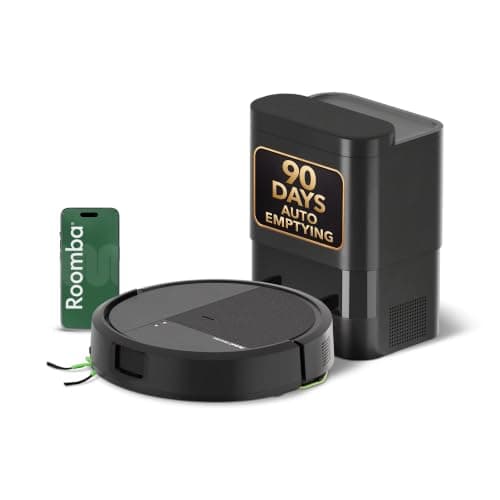
This is the first Roomba we have ranked that tells you how much suction you are buying. It launched as the cheapest self-emptying machine on this site; its price has since climbed well above the ceiling this site is about, and we say so below rather than leaving the old framing up.
By Scooter M., Enthusiast - published October 3, 2026
We have not tested these machines. Everything here comes from published specifications, manufacturer manuals and retailer listings, all cited below. Prices last verified November 22, 2026.
How this is funded: if you buy through a link here we may earn a commission, at no extra cost to you. It does not change which machines we recommend or what we say about them. Full disclosure.
The Roomba 115X Combo arrives with something this site has complained about for months: a published suction figure. iRobot states 15,000 Pa and a dock rated at 90 days, a longer stated interval than its own 105 with AutoEmpty. Two cautions, and the second one is new. The headline number is brand new from a brand that has never printed one, and you cannot check it against anything else iRobot sells. And this machine launched near the $200 mark but is now selling for well over this site's $300 ceiling - at that price the argument for buying it instead of the 105 with AutoEmpty is gone, and we would buy the 105.
#
Product
Best for
Score
Price
01
iRobot Roomba 115X ComboThe highest Pascal figure iRobot prints, with the longest dock interval it states. The number is new enough to deserve skepticism - iRobot began publishing Pa figures across this range only in late 2026 - and the price has since climbed well above this site's ceiling.
Scores come from the published rubric on How We Pick: suction 25%, navigation 25%, pet hair 20%, running cost 20%, setup 10%. Editorial judgments about published specifications, not test results.
The thing that actually changed
This matters beyond one listing. The single most-repeated criticism on this site is that a brand which will not print a number cannot be ranked against brands that do. iRobot has now printed one on its new machines, which removes that objection for those models and leaves it standing for the rest of the range.
What the specifications actually say
Suction: 15,000 Pa. That is the highest published figure of any machine we rank - above the Lefant M3's 12,000 Pa and well above the 10,000 Pa Roborock prints. Three honest qualifications. Pascal ratings have no shared test standard between manufacturers, so this is not a measurement you can hold against a rival's number with any confidence, and we explain why on Pa suction explained. It is a brand-new claim from a brand with no track record of making it. And it cannot be compared backwards against iRobot's own 105 line, because those machines still publish a ratio rather than a figure.
The dock: 90 days, 2.5 liters, and a bag that seals itself. This is the strongest part of the machine and the least ambiguous. iRobot states up to 90 days between bag changes, which is longer than the 75 days it claims for the 105 AutoEmpty and longer than the 7-to-9 weeks Roborock states for the Q7 M5+. The AllergenLock bag is stated to trap 99% of pollen and mold and to seal as you remove it, which is the specific thing that matters in a dust-sensitive household - emptying is when a bin releases its contents back into the room. The general argument is on is a self-emptying dock worth it.
Navigation: ClearView LiDAR, with an obstacle claim attached. The mapping is the same family as the rest of the 100 series - laser, neat rows, works in low light. What is new in the wording is that iRobot now states the machine steers around shoes, pet bowls and furniture. That is an obstacle-avoidance claim rather than a mapping claim, and the distinction is one we labor on obstacle avoidance, because LiDAR alone does not see a sock.
Anti-hair-wrap brushes. Another first for a Roomba on this site. iRobot has never made an anti-tangle claim for the 105 line, and that gap is the single biggest reason we have pointed pet owners at Roborock. The claim here is less specific than Roborock's - iRobot does not say whether the side brush is covered, and the side brush is where long hair wraps worst - but it is a claim where there used to be silence. See best for pet hair for why that distinction decides things.
Mopping: a washable pad, not a pump. This is where the cheaper price shows. The pad is microfiber, there is a SmartScrub mode stated at "2x deeper", and three water levels - but it is a pad dragged across the floor, not the micro-pump metering water on the 105 Combo or a vibrating plate. It also does not lift, so rugs need a No Mop Zone drawn around them in the app rather than being detected and avoided automatically.
Coverage: 900 sq ft per charge. Modest, and the number to pay attention to if your home is large. Recharge-and-resume is not stated on this listing the way it is for the 105 line, which matters more than the suction figure for anybody over about 1,200 square feet - see best for large homes.
The price is the real story, not the Pascal figure
Strip out the new number and this is still the most interesting machine iRobot sells at this price, because a 90-day self-emptying dock has not been available this cheap before on this site. The Tikom L8000 Plus has held the cheapest-dock position for months and this undercuts it, from a brand with far better app support and parts availability.
There is also a version without the dock at a lower price. If the dock is not the reason you are here, that variant exists - but the dock is the reason this machine is interesting, and buying the dockless one puts you back among a crowded field of mapping machines where the 15,000 Pa claim is doing all the work.
Should you believe 15,000 Pa?
Partly, and here is the honest shape of it. A published figure is better than no figure, because it is a claim the manufacturer has committed to in writing and can be held to. That is a real improvement over "70x more power-lifting suction", which is a comparison to a machine from around 2012 and cannot be checked by anybody.
But a Pascal rating is a measurement each brand takes its own way, and a number arriving suddenly at the top of the category from a brand that has spent years saying such numbers are meaningless deserves to be read with one eyebrow raised. We have not measured it and we are not going to pretend otherwise. What we will say is that we would not buy this machine because of the 15,000 Pa - we would buy it because of the dock and the price, and treat the suction figure as a welcome change in disclosure rather than as a proven capability.
Roomba 115X Combo or Roomba 105 AutoEmpty?
You want the longest stated dock interval: the 115X. 90 days against 75, and it mops as well. Note that it no longer undercuts the 105 AutoEmpty on price - it now costs considerably more.
Somebody in the house has a dust allergy: look closely at both. The 105 AutoEmpty publishes a 0.7-micron filtration figure; the 115X states 99% of pollen and mold without a micron number. The finer published figure is on the older machine.
You want the most mature, most-tested version of iRobot's software: the 105 line has been out longer. The 115X is new enough that there is no track record at all.
Against the rest of the field, the comparison that matters is Roborock vs Roomba - and this machine changes that page's arithmetic for the first time, because iRobot is no longer conceding the specification argument by default.
Who should buy it
Somebody with a small-to-medium home who wants to stop emptying a bin, wants iRobot's app and parts availability, and does not want to pay what iRobot's older dock machine costs. On that description this is the best-value Roomba on this site, and the first one in a while that is genuinely interesting rather than merely competent.
It is not the machine for a large floor plan, for a home that is mostly carpet where you need the mop to stay away on its own, or for a buyer who wants a long track record before spending money. On all three of those, something older is the safer purchase.
What we did not verify
We have not handled this machine. Everything above is read from published specifications and the manufacturer's own documentation, cited below. These are the specific claims we could not check:
The 15,000 Pa figure. We have not measured it, Pascal ratings have no shared test standard between brands, and this is the first machine from this manufacturer to carry one.
How 15,000 Pa relates to iRobot's older '70x power-lifting suction' language. The two cannot be converted into each other and iRobot does not bridge them.
The 90-day dock interval, and how much it shortens in a home with pets or heavy carpet.
The AllergenLock bag's '99% of pollen and mold' claim. No micron figure is published for this model, unlike the 0.7-micron claim on the 105 AutoEmpty.
The anti-hair-wrap claim, and specifically whether it covers the side brush as well as the main brush. The listing does not say.
What SmartScrub's '2x deeper' is measured against. iRobot does not state the comparison.
Whether recharge-and-resume is supported. It is stated for the 105 line and does not appear on this listing.
The height of the machine. iRobot publishes no height figure, so we cannot tell you whether it fits under your furniture.
Noise. No decibel figure is published, by iRobot or by anyone else in this price range.
Long-term reliability. This is a new model with no track record.
That list is not a disclaimer bolted on at the end. It is the actual scope of this review, and anywhere a competitor's confident phrasing implies they checked these things without saying how, it is worth asking the same question of them.
The highest Pascal figure iRobot prints, with the longest dock interval it states. The number is new enough to deserve skepticism - iRobot began publishing Pa figures across this range only in late 2026 - and the price has since climbed well above this site's ceiling.
Published specifications
Suction
15,000 PaSource: Manufacturer listing - the highest published Pa figure on any iRobot machine we rank
Navigation
ClearView LiDAR, cleans in neat rows in low light, states it steers around shoes, pet bowls and furnitureSource: Manufacturer listing
Self-emptying
AutoEmpty dock with a 2.5 L AllergenLock bag, stated up to 90 days; bag seals on removalSource: Manufacturer listing
Dock filtration
Bag stated to trap 99% of pollen and moldSource: Manufacturer listing
Mopping
Washable microfiber pad with SmartScrub, stated 2x deeper; No Mop Zone keeps it off rugsSource: Manufacturer listing
Coverage
Up to 900 sq ft per chargeSource: Manufacturer listing
Brushes
Anti-hair-wrap brushes, plus an extended mop pad and edge-sweeping brush for cornersSource: Manufacturer listing
Cleaning levels
1-2 passes, 4 suction levels, 3 water or solution levelsSource: Manufacturer listing
Wi-Fi
2.4 GHz required for setupSource: Manufacturer listing
What it gets right
A self-emptying dock stated at 90 days - the longest interval iRobot states on any machine we rank
iRobot finally publishes a suction figure - 15,000 Pa - instead of a ratio against its own 2012 machine
An anti-hair-wrap claim, which iRobot has never made for the 105 line
ClearView LiDAR with a stated obstacle-avoidance behavior, not just mapping
The AllergenLock bag seals as you pull it out, so emptying releases no dust cloud
What it gives up
15,000 Pa is a brand-new claim from a brand that spent years refusing to publish one, and Pascal figures have no shared test standard between manufacturers
It cannot be compared backwards against iRobot's own 105 line, which still quotes a ratio rather than a number
900 sq ft per charge is modest - this is a small-to-medium-home machine
The mop is a washable pad, not the micro-pump of the 105 Combo or a vibrating plate
The pad does not lift, so rugs need a No Mop Zone drawn around them
iRobot consumables cost more, and the listing asks for filters and brushes every 3 to 6 months
It launched near the $200 mark and the live price has since climbed well past this site's $300 ceiling, which undoes the only argument for buying it over iRobot's own 105 AutoEmpty
Our scoring
Suction9.0
Navigation8.5
Pet hair7.5
Running cost6.0
Setup8.5
Weights and the arithmetic behind the total are published on How we pick so you can recompute this yourself.
Who it is for: Somebody who specifically wants a self-emptying Roomba with a published suction figure and is willing to pay well over this site's ceiling to get one. At the price it is selling for now we would buy the 105 with AutoEmpty instead.
Skip it if: you are shopping the budget tier this site exists for. At its current price this machine is no longer a budget pick, and iRobot's own 105 with AutoEmpty does the same job inside the ceiling. It is also a small-to-medium-home machine: 900 sq ft per charge is the published figure, and recharge-and-resume is not stated on this listing the way it is on the 105 line.
Questions people actually ask
+−Is the Roomba 115X Combo worth it?
Not at the price it is selling for now. The 90-day stated bag interval is the longest iRobot quotes and it beats the 105 AutoEmpty on that one measure, but this machine launched near the $200 mark and now sells well above this site's $300 ceiling - more than the 105 AutoEmpty it used to undercut. If you want a self-emptying Roomba, buy the 105 with AutoEmpty instead; if you just want the cheapest self-emptying machine, that is the ILIFE A30 Pro or the Tikom L8000 Plus, which sit within about ten dollars of each other. Either way, do not buy this one for the 15,000 Pa headline, which is a brand-new claim with no track record behind it.
+−Does the Roomba 115X Combo really have 15,000 Pa suction?
That is the figure on iRobot's own listing, and it is the first Pascal rating the brand has published on any machine we rank. Treat it as a disclosure improvement rather than a proven capability - Pascal ratings have no shared test standard between manufacturers, and we have not measured it.
+−How long does the Roomba 115X Combo dock last between bags?
iRobot states up to 90 days on a 2.5-liter AllergenLock bag, which seals as you remove it. That is longer than the 75 days claimed for the 105 AutoEmpty and longer than most bagged docks at this price.
+−Does the Roomba 115X Combo mop?
Yes, with a washable microfiber pad and a SmartScrub mode. It is a pad rather than a pumped or vibrating system, and the pad does not lift, so you draw a No Mop Zone around rugs in the app instead of relying on automatic carpet detection.
+−Is the Roomba 115X Combo better than the Roomba 105 AutoEmpty?
On dock interval, price and mopping, yes. On filtration the older machine publishes a finer figure - 0.7 microns against this machine's unquantified 'traps 99% of pollen and mold' - and it has a longer track record. If allergies are the reason you want a dock, compare the two carefully.
+−Is the Roomba 115X Combo good for a large house?
No. iRobot states up to 900 square feet per charge, and recharge-and-resume does not appear on this listing the way it does for the 105 line. This is a small-to-medium-home machine.
Sources
Every specification quoted above was read off one of these documents on the date shown. Where a manufacturer does not publish a figure, this site says "Not published" rather than estimating it.
iRobot range check, 2026-10-03The current iRobot line-up was read to confirm the change in disclosure is line-wide rather than a single listing: the 115X states 15,000 Pa, the 415X states 20,000 Pa and the Max 715 Pet states 30,000 Pa with anti-tangle brushes, while the older 105 and 505X/705X models still quote relative '70x' and '175x' claims. Both 115X variants - with and without the AutoEmpty dock - were confirmed in stock with new-condition offers.