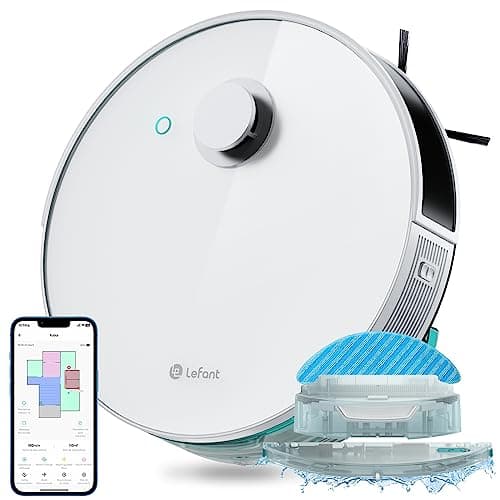
Almost every machine at this price drags a damp cloth. This one drives the cloth, and pairs it with a better navigation sensor than its price suggests. The suction figure is the compromise.
By Scooter M., Enthusiast - published September 13, 2026
We have not tested these machines. Everything here comes from published specifications, manufacturer manuals and retailer listings, all cited below. Prices last verified September 21, 2026.
How this is funded: if you buy through a link here we may earn a commission, at no extra cost to you. It does not change which machines we recommend or what we say about them. Full disclosure.
The Lefant N3 is the best mopping machine under $200 on this site, and the reason is mechanical rather than marketing: its pad oscillates 12,000 times a minute instead of being dragged, so it agitates dried marks a passive cloth glides over. It also fits dToF LiDAR, a better sensor than the plain LiDAR most machines at this price use. The compromise is real - 4,000Pa is the lowest published suction figure of any mapped machine we rank - and there is no self-emptying dock.
#
Product
Best for
Score
Price
01
Lefant N3A sonic mop that vibrates 12,000 times a minute, which is a genuinely different mechanism from the damp cloth every other machine at this price drags around.
Scores come from the published rubric on How We Pick: suction 25%, navigation 25%, pet hair 20%, running cost 20%, setup 10%. Editorial judgments about published specifications, not test results.
What the specifications mean in a real home
Sonic mopping at 12,000 vibrations a minute. Lefant's own comparison is a sonic toothbrush, and it is the right one. A passive pad - what almost every machine under $300 has - is a damp cloth pulled across the floor by the machine's own movement, which lifts a film of dust and does nothing to anything dried on. A driven pad moves *relative* to the floor, which is what breaks a dried coffee ring or a milk splash. Only a handful of machines at this price publish an oscillation rate at all, and our mop combo ranking sorts the field by exactly that test.
dToF LiDAR, stated to detect at 10 meters and to be unaffected by light. This is the specification most buyers skip past and it is the one that decides whether the map is any good. Direct time-of-flight measures how long a light pulse takes to return rather than reading its intensity, so it does not care whether the room is sunlit or pitch dark. Cheaper LiDAR modules drift in bright rooms with reflective floors - which is to say, in kitchens. Our navigation explainer sets out how the sensor tiers differ.
4,000Pa across four levels. This is the machine's weakest published number and it should be weighed honestly. It is the lowest figure of any LiDAR machine on this site - the Lefant M3 publishes 12,000Pa and the Roborock Q7 M5+ 10,000Pa. Lefant describes it as handling fine dust, crumbs, oatmeal and hair on hard floors, which is a carefully scoped claim and, we think, an accurate description of the job this machine is built for. It is not a carpet machine.
Ultrasonic carpet detection that changes behavior in two directions. Vacuuming, it raises suction when it meets pile. Mopping, Lefant states it changes direction when it detects carpet rather than driving on. That second behavior is worth more than it sounds: a damp pad dragged onto a rug is the single commonest failure in this category, and most machines at this price need a no-mop zone drawn by hand to avoid it.
A 160 ml electronic tank with three flow levels. Small. The Tapo and Tikom machines carry 300 ml. On a kitchen and a hallway that is fine; on a large open-plan hard floor it means a refill mid-run, which defeats the point of an unattended machine. The three flow levels matter for floor type - a drier pass on sealed hardwood, a wetter one on tile - and our hardwood ranking explains why that setting does more work than tank size.
200 minutes, a claimed 3,200 sq ft, and recharge-and-resume. Lefant states the machine returns to charge and then continues where it left off, which is what makes a large floor plan a single job rather than a restart. Read the 200 minutes as the vacuum-only maximum: driving a pad at 12,000 cycles a minute is work, and it comes out of the same battery.
No-go zones, invisible walls and partition cleaning in the app, plus Alexa and Google Home. Note the Wi-Fi: 2.4 GHz only, which is normal for the category and worth knowing if your router likes to hand devices to the 5 GHz band - that is the commonest first-day setup failure in this whole category.
One thing on the listing we could not reconcile
The specification table on the N3's own listing includes Automatic Dust Collection in its feature list. Nothing else on that listing describes a base station: the bullets cover self-charging and resuming, not self-emptying, and no dock capacity or bag size is published anywhere on the page.
We score that as unverified rather than true, and we would buy this machine expecting to empty its bin by hand. It is the kind of discrepancy worth checking on any listing before you spend: a feature that appears in the attribute table and nowhere in the description usually means an attribute filled in loosely, not a feature in the box. If a dock is what you are shopping for, our self-emptying ranking only lists machines whose dock capacity is actually published.
Who should buy it
A hard-floor home where the floor genuinely gets dirty - a kitchen that gets cooked in, a hallway that takes shoes, a house with small children. That is the specific case where the difference between a driven pad and a dragged one shows up on the floor rather than only on the specification sheet.
It also suits somebody who wants mapping and zones on a firm budget. At this price the alternatives are mostly a choice between a map and a mop; the N3 is the machine that declines to make you choose.
Who should not
Anyone with mostly carpet. You would be buying a mopping platform you cannot use, and paying for it with the lowest published suction figure of any mapped machine here. The best for carpet ranking is a different shortlist.
Anyone with a shedding pet. Lefant names no anti-tangle mechanism for the N3's brush, so long hair wraps and gets cut out by hand. Our pet hair ranking is ordered by brush design for exactly this reason.
Anyone who wants to stop emptying a bin. There is no dock you can rely on here. If the bin is the chore you are trying to remove, read is a self-emptying dock worth it first - the honest answer for a pet household is yes.
Anyone with a large hard-floor area. The 160 ml tank is the constraint, not the battery.
Alternatives at this price
The Tapo RV30 Max Plus sits at a similar price and trades the sonic mop for a 3-liter self-emptying dock and inertial navigation - the better buy if the bin bothers you more than the mop does. The Lefant M3 costs more and adds a dock that washes the pad, though its mop is passive. And the under $200 band page ranks the whole shortlist against live prices.
If you are weighing brands rather than machines, Lefant against Roborock is where the specification-sheet question gets picked apart, and Lefant against eufy covers the map-or-no-map decision at the bottom of the market.
What we did not verify
We have not handled this machine. Everything above is read from published specifications and the manufacturer's own documentation, cited below. These are the specific claims we could not check:
Whether the sonic pad clears a specific dried mark. Lefant publishes a rate, not a cleaning result, and we have not mopped anything with it.
The 3,200 sq ft coverage claim, which is a manufacturer figure in the most efficient mode rather than a mopping figure.
Whether 4,000Pa is enough on low-pile carpet. No pickup figure is published for any surface, and Pascal ratings have no shared test standard.
Automatic Dust Collection, which appears in the listing's attribute table and nowhere in its description - we treat the machine as one you empty by hand.
How reliably ultrasonic carpet detection turns the machine away in mop mode - no detection rate is published.
Body height. Lefant does not state it for this model, so we cannot tell you what furniture it clears.
Battery longevity and noise. No cycle count and no decibel figure are published, which is true of almost every machine in this tier - see our battery life guide.
That list is not a disclaimer bolted on at the end. It is the actual scope of this review, and anywhere a competitor's confident phrasing implies they checked these things without saying how, it is worth asking the same question of them.
A sonic mop that vibrates 12,000 times a minute, which is a genuinely different mechanism from the damp cloth every other machine at this price drags around.
Published specifications
Suction
Up to 4,000Pa, 4 levelsSource: Manufacturer listing
Navigation
LiDAR plus dToF sensors, detection to 10 m, real-time mappingSource: Manufacturer listing
Mopping
Sonic scrubbing at 12,000 vibrations per minuteSource: Manufacturer listing
Water tank
160 ml electronic, 3 levelsSource: Manufacturer listing
Runtime
Up to 200 minutes; manufacturer states 3,200 sq ftSource: Manufacturer listing
Carpet detection
Ultrasonic, raises suction and changes direction in mop modeSource: Manufacturer listing
What it gets right
Sonic scrubbing actually agitates dried-on marks instead of spreading them, which a passive pad cannot do
dToF is a better sensor than the bare LiDAR most machines at this price use - it is unaffected by ambient light
200 minutes and a claimed 3,200 sq ft covers a whole house in one run
Ultrasonic carpet detection means it stops wetting rugs without you drawing zones
What it gives up
4,000Pa is the lowest published figure of any LiDAR machine here
A 160 ml tank is small - a large hard-floor area will need a refill mid-run
No self-emptying dock
Sonic mopping consumes battery faster than a passive pad, so 200 minutes is the vacuum-only figure
Our scoring
Suction6.5
Navigation8.0
Pet hair6.0
Running cost8.0
Setup7.5
Weights and the arithmetic behind the total are published on How we pick so you can recompute this yourself.
Who it is for: Hard floors that actually get dirty - a kitchen, a hallway, a house with children.
Skip it if: your floors are mostly carpet. You would be paying for a mopping mechanism you cannot use and taking the weakest suction figure in the LiDAR group to get it.
Questions people actually ask
+−Is the Lefant N3 worth it?
For a hard-floor home where mopping is the point, yes - it is the cheapest machine on this site whose mop uses a published mechanism, 12,000 sonic vibrations a minute, rather than dragging a damp cloth. For a carpeted home, no: 4,000Pa is the lowest published suction of any mapped machine we rank.
+−Does the Lefant N3 really scrub the floor?
Lefant publishes a sonic scrubbing rate of 12,000 vibrations per minute, which means the pad is driven by a motor rather than pulled along by the machine's movement. That is the mechanical difference between agitating a dried mark and gliding over it. We have not tested the result.
+−Does the Lefant N3 have mapping?
Yes - dToF LiDAR that Lefant states detects at up to 10 meters and is unaffected by ambient light, with real-time mapping. In the app you get no-go zones, invisible walls, partition cleaning and scheduling.
+−Will the Lefant N3 mop my carpet by mistake?
Lefant states ultrasonic carpet detection changes the machine's direction in mop mode when it meets pile, rather than driving on and wetting it. That is unusual at this price - most machines need a no-mop zone drawn by hand - though no detection rate is published, so we score it as a claim rather than a measurement.
+−Does the Lefant N3 empty itself?
No dock capacity or bag size is published anywhere on its listing, and the description covers self-charging rather than self-emptying, so plan on emptying the bin yourself. The attribute table does list Automatic Dust Collection, which nothing else on the listing supports - we score it as unverified.
+−How long does the Lefant N3 run for?
Lefant publishes up to 200 minutes and a claimed 3,200 sq ft on a full charge, with recharge-and-resume so a large floor plan finishes in one job. Treat 200 minutes as the vacuum-only maximum - driving the sonic pad draws from the same battery.
+−Have you tested the Lefant N3?
No. This review is built from Lefant's published specifications and its own listing, cited at the bottom of the page, and it carries an explicit list of the claims we could not check.
Sources
Every specification quoted above was read off one of these documents on the date shown. Where a manufacturer does not publish a figure, this site says "Not published" rather than estimating it.