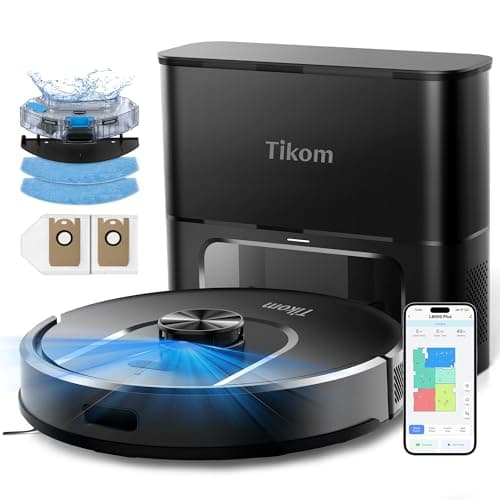
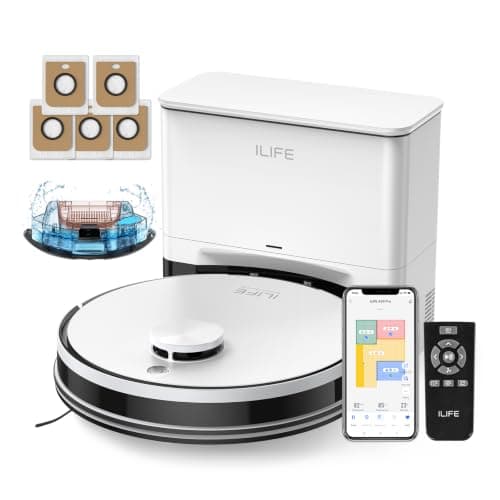
These are the two cheapest machines with a real self-emptying dock that we can currently verify as buyable, and they are separated by about the cost of a sandwich. They are not the same machine with different badges, and the thing that decides between them is your floor.
By Scooter M., Enthusiast - published November 7, 2026
We have not tested these machines. Everything here comes from published specifications, manufacturer manuals and retailer listings, all cited below. Prices last verified November 22, 2026.
How this is funded: if you buy through a link here we may earn a commission, at no extra cost to you. It does not change which machines we recommend or what we say about them. Full disclosure.
If you have any carpet at all: buy the Tikom L8000 Plus. It states automatic suction boost on carpet, and ILIFE's own surface recommendation for the A30 Pro stops at low-pile. If your floors are hard, and you want the biggest published number and the longest stretch before you spend again: buy the ILIFE A30 Pro - 10,000Pa against 6,000Pa, and five dust bags in the box rather than an unstated number. Neither machine claims an anti-tangle mechanism of any kind, so if anyone in the house sheds, the honest answer is neither of them.
This page exists because this site has spent several months telling readers that these two are the cheapest self-emptying machines it can verify, and within about ten dollars of each other - which raises an obvious question it had not answered anywhere: so which one? They arrive at nearly the same price from genuinely different directions, and a buyer who picks on price alone has a one-in-two chance of getting the wrong one for their home.
#
Product
Best for
Score
Price
01
ILIFE A30 ProA self-emptying LiDAR machine publishing 10,000Pa for under two hundred dollars, which is a combination nothing else here manages. The headline 280-day figure is five bags, not one.
Both machines scored on the published rubric from How We Pick: suction 25%, navigation 25%, pet hair 20%, running cost 20%, setup 10%. Editorial judgments about published specifications, not test results.
What is actually identical
More than you would expect, and clearing it out of the way first makes the real differences visible. Both navigate with LiDAR and both publish smart mapping with no-go zones and virtual walls, so neither is the compromise on navigation - the mechanics are in robot vacuum navigation, explained. Both state up to 150 minutes in their gentlest suction mode, and both state auto-recharge and resume, so on a large floor plan both will finish the job across two passes rather than abandoning it. Both vacuum and mop. And both empty into a bag you keep buying, which is the cost neither listing puts on the front of the box.
Both also share the same omission: neither manufacturer claims any anti-tangle geometry, on either brush. That is not a small thing at these suction figures, and it is treated properly further down rather than buried in a table.
Specification by specification
Every figure read from the two manufacturers' current listings
Specification
ILIFE A30 Pro
Tikom L8000 Plus
What it means here
Suction
Up to 10,000Pa, adjustable in the app
Up to 6,000Pa, automatic boost on carpet
The headline gap - but only one of them states what happens on carpet
Dock interval
2.5 L station; up to 280 days stated across the 5 bags supplied
3 L bag; up to 90 days stated
Different kinds of claim entirely. See the arithmetic below
Bags in the box
5, stated
Not published
The clearest first-year cost difference, and only one side states it
Maps saved
Smart mapping and route planning; no map count published
Up to 5 saved floor maps
Only one of them is checkable against a three-story house
Separate no-mop zones keep it off a rug without banning the room
Surfaces on the maker's own field
Hard floor, tile, laminate, marble, low-pile carpet
Not restricted; states automatic carpet boost
The single hardest constraint on this page
Dustbin and tank
2-in-1 integrated: 200 ml bin and 200 ml tank, used together
3 water flow settings; bin volume not published
On the ILIFE, mopping costs you dust capacity
Runtime
Up to 150 minutes, auto-recharge and resume
Up to 150 minutes, auto-recharge and resume
Identical on paper
Control
App, voice, and an included physical remote
App and voice; no remote published
Matters if the machine is for somebody who will not install an app
Anti-tangle
Not published for either brush
Not claimed; conventional main brush
The gap both machines share
Height
Not published
Not published
Neither can be checked against your lowest furniture before buying
Read from each manufacturer's own listing on the day of publication, and nothing is carried across from a similar model. Where a manufacturer does not publish something it is recorded as not published rather than estimated or inferred from a sibling machine.
The 280 days and the 90 days are not the same claim
This is the most misleading-looking line on either listing, and it is worth being precise because the two numbers invite a comparison that does not hold.
ILIFE's 280 days is the five supplied bags added together. The listing says so itself - a 2.5 L station and five dust bags, up to 280 days of hands-free cleaning. Divide it out and each bag is running roughly eight weeks. Tikom's 90 days is one bag. So on the figure that actually describes how often you walk to the dock, the Tikom states the longer interval by a comfortable margin, and the ILIFE number is a consumables-included claim wearing a capacity claim's clothes.
The floor decides this, not the specification sheet
If you take one thing from this page, take this. ILIFE's own Surface Recommendation field for the A30 Pro reads: hard floor, tile, laminate, marble and low-pile carpet. That is the manufacturer setting the limit, not us inferring one. The Tikom's listing sets no equivalent restriction and states automatic suction boost on carpet, which is a claim about what the machine does when it drives onto pile.
So a 10,000Pa machine that its own maker caps at low-pile is not the carpet machine in this pairing, and the 6,000Pa machine that boosts is. A Pascal figure becomes cleaning on carpet only when something agitates the pile and the machine knows to try harder - which is the whole argument on robot vacuums on carpet, and the ranked field is on best for carpet.
What the Tikom does better
It names its map count. Up to five saved floor maps is a specific, checkable claim that covers a three-story house. ILIFE states smart mapping and route planning without putting a number on it, so on a multi-floor home one of these two is verifiable in advance and the other is not.
It separates no-mop zones from no-go zones, and adds room selection. That distinction sounds like spec-sheet filler until you own a rug: a no-mop zone keeps the wet pad off it without banning the machine from the room the rug is in. ILIFE publishes no-go zones and virtual walls, which is the blunter version of the same tool.
It states the longer interval on a single bag, which is the figure that describes the chore rather than the shopping. Ninety days is the longest single-bag interval anything we rank states at any price - only the Lefant M3 matches it, and nothing beats it - and it is the reason this machine holds our longest-interval award rather than the cheaper one.
It does not restrict its own surface list. Everything above about carpet comes back to this one line.
What the ILIFE does better
It is cheaper, and it is the cheapest machine with a real self-emptying dock we can currently verify as buyable. On a site built around a $300 ceiling that is the headline, even though the gap between these two is small enough that it should not decide the purchase on its own.
Five bags in the box. Most machines here ship with one. This is the most concrete thing on the ILIFE listing and it is worth real money in the first year - and, as above, Tikom does not state its own bag count, which is an answer of a sort.
A published 10,000Pa, which is the highest figure of any dock machine we rank. With the carpet caveat above fully applied, on hard floors and low pile that is a genuine advantage and it is why this machine scores higher than the Tikom on suction in our rubric.
It ships a physical remote as well as the app. That is not a specification anybody shops on, right up until the machine is a gift for somebody who will not install an app, at which point it is the only specification that matters.
The thing neither of them does
Neither machine claims an anti-tangle mechanism. Tikom's listing describes a conventional main brush and claims no geometry against wrapping; ILIFE makes no anti-tangle claim for either brush. In a shedding household that single shared gap outranks the suction figure, the dock interval and the map count combined, because a brushroll bound with hair stops cleaning no matter what the fan behind it is doing - and a dock does not help, since you will be cutting hair off a roller long before you change a bag.
At a similar price the Roborock Q7 M5+ names an anti-tangle main brush and an anti-tangle side brush - the half most claims leave out - while keeping a self-emptying dock. The ranked answer for a shedding home is best for pet hair, and if that describes your house we would not buy either machine on this page.
Two smaller shared gaps are worth naming. Neither publishes a robot height, so neither can be checked against a low sofa before you buy - the machines that do publish one are ranked on best for low furniture. And neither claims structured-light obstacle avoidance, so both will meet a sock the hard way; the five different things that share that name are separated on what obstacle avoidance actually means at this price.
Which one we would buy
For a home with any carpet: the Tikom L8000 Plus. The automatic boost claim and the absence of a surface restriction settle it, and the five saved maps and separate no-mop zones are the better map tooling of the two. You are giving up the bigger published suction number and four spare bags to get there.
For a hard-floor home: the ILIFE A30 Pro. It costs less, publishes the higher figure in the conditions where that figure applies, and the five bags mean roughly nine months before you spend anything on it. You are giving up the longer single-bag interval, the named map count and the no-mop zones.
For a shedding household: neither. Spend the same money on anti-tangle brushes and accept a different compromise. And if you have not yet decided whether a dock is worth paying for at all, is a self-emptying robot vacuum worth it is the argument to read before either of these - it is a recurring cost dressed as a convenience, and it is not right for everybody.
What we did not verify
We have not handled either machine and we have tested nothing on this page. Every figure above is quoted from the two manufacturers' current listings and cited below: ILIFE's 10,000Pa, its 2.5 L station with five bags and a stated 280 days, its low-pile surface recommendation and its 200 ml 2-in-1 bin and tank; Tikom's 6,000Pa with automatic carpet boost, its 3 L bag with a stated 90 days, its five saved maps and its no-mop zones. The eight-week-per-bag figure is arithmetic on ILIFE's own two numbers, not a published figure. We have not measured suction on either machine, confirmed that either dock reaches its stated interval in a real home, established how many bags ship with the Tikom, or verified that the ILIFE struggles on medium pile - we are reporting that its maker does not recommend it there, which is a different and weaker statement. Neither manufacturer publishes a robot height, so neither is ranked for clearance.
A self-emptying LiDAR machine publishing 10,000Pa for under two hundred dollars, which is a combination nothing else here manages. The headline 280-day figure is five bags, not one.
Published specifications
Suction
Up to 10,000Pa, adjustable in the appSource: Manufacturer listing
Self-emptying
2.5 L station. ILIFE states up to 280 days of hands-free cleaning across the 5 dust bags suppliedSource: Manufacturer listing - the figure covers five bags, not one
Navigation
LiDAR with smart mapping and route planning; no-go zones and virtual walls in the appSource: Manufacturer listing
Dustbin / water tank
2-in-1 integrated tank: 200 ml dustbin and 200 ml water tank, used togetherSource: Manufacturer listing
Runtime
Up to 150 minutes in gentle suction mode, auto-recharge and resumeSource: Manufacturer listing
Control
App, included remote and voice; Alexa and Google AssistantSource: Manufacturer listing
Surfaces
Hard floor, tile, laminate, marble and low-pile carpetSource: Manufacturer listing - Surface Recommendation field
Anti-tangle
Not publishedSource: ILIFE makes no anti-tangle claim for either brush on this listing
Height
Not publishedSource: ILIFE states no robot height on this listing
What it gets right
A self-emptying dock, real LiDAR mapping and a published 10,000Pa, all under two hundred dollars - nothing else here does all three at this price
Five dust bags in the box, where most machines here ship with one
Auto-recharge and resume, so a large floor plan is one job rather than three
A physical remote as well as the app, which matters if the machine is for somebody who will not install one
No-go zones and virtual walls, the part of a map that actually changes daily use
What it gives up
The 280-day headline is five bags' worth, not one bag - on ILIFE's own numbers each bag is closer to eight weeks, which is shorter than the 90 days the Tikom and Lefant docks state
No anti-tangle claim of any kind, for either brush, which at this suction figure is a conspicuous omission in a shedding household
A 200 ml dustbin shared with a 200 ml water tank, so mopping costs you dust capacity on a machine whose selling point is not emptying it
Low-pile carpet only on ILIFE's own surface recommendation
No published height, so there is no way to check it against your lowest furniture before buying
2.4 GHz Wi-Fi only, which is a nuisance on a mesh network
Our scoring
Suction9.0
Navigation7.5
Pet hair7.0
Running cost7.0
Setup8.0
Weights and the arithmetic behind the total are published on How we pick so you can recompute this yourself.
Who it is for: Somebody who wants the dock and the map on the smallest budget that buys both, and whose floors are hard with at most low-pile rugs.
Skip it if: anyone in the house sheds. ILIFE claims nothing about hair wrap on either brush, and at 10,000Pa you will be collecting a great deal of hair into a machine with no published answer for what happens to it.
3 suction levels, 3 water flow settingsSource: Manufacturer listing
What it gets right
Ninety days between bag changes is 50% longer than the Tapo docks and beats most flagships
Five saved maps handles a three-story house, which is unusual under $250
Separate no-mop zones, so you can keep it off a rug without banning it from the room
6,000Pa published, with automatic carpet boost
What it gives up
Bags are still a recurring cost, just a less frequent one
150 minutes is mid-pack, and a big home will need the resume feature to finish
A conventional main brush - no anti-tangle geometry is claimed
Tikom is a small brand; spare-part availability in three years is a genuine unknown
Our scoring
Suction8.0
Navigation8.0
Pet hair6.5
Running cost6.5
Setup7.5
Weights and the arithmetic behind the total are published on How we pick so you can recompute this yourself.
Who it is for: A multi-floor home where the dock is somewhere inconvenient and you want to visit it as rarely as possible.
Skip it if: you have long-haired pets. Nothing in this machine's published specification addresses hair wrap, and at a similar price the Roborock Q7 M5+ and the Ecovacs N20 Plus both name an anti-tangle mechanism.
Questions people actually ask
+−Is the ILIFE A30 Pro or the Tikom L8000 Plus better?
Neither wins outright, and the floor decides it. Buy the Tikom L8000 Plus if you have carpet: it states automatic suction boost on pile and sets no surface restriction. Buy the ILIFE A30 Pro if your floors are hard: it costs less, publishes 10,000Pa against 6,000Pa, and ships five dust bags where most machines ship one. For a shedding household the answer is neither, because neither claims any anti-tangle design.
+−Does the ILIFE really go 280 days without emptying?
No, and the listing does not quite say that. The 280 days is the five supplied dust bags added together, not the capacity of one bag - ILIFE states a 2.5 liter station and five bags in the same bullet. Divided out, each bag runs roughly eight weeks. Tikom's 90 days, by contrast, is the interval on a single 3 liter bag, so on the figure that describes how often you visit the dock the Tikom states the longer one.
+−Which one is better on carpet?
The Tikom L8000 Plus, clearly. Its listing states automatic suction boost when it drives onto carpet and places no restriction on surface type. ILIFE's own Surface Recommendation field for the A30 Pro stops at low-pile carpet, which is the manufacturer setting the limit rather than a reviewer inferring one. A large Pascal figure does not override the maker's own surface guidance.
+−Is 10,000Pa twice as good as 6,000Pa?
No. There is no shared test standard behind a Pascal rating, so a figure from one manufacturer and a figure from another are not two points on the same scale. The number is useful for placing a machine within its own brand's range. On carpet, whether the machine agitates the pile and boosts when it detects it matters far more than the headline figure.
+−Do both of them need bags?
Yes, both docks are bagged, so both carry a recurring cost. The difference is what comes in the box: ILIFE states five bags supplied, and Tikom does not publish a bag count at all. At the stated intervals that is roughly nine months of running before the ILIFE needs a consumable, against about four bags a year on the Tikom. If avoiding the bag entirely matters, a bagless dock is the thing to look for instead.
+−Which is better for pet hair?
Neither, and it is worth being blunt about it. Neither listing claims any anti-tangle mechanism - Tikom describes a conventional main brush and ILIFE makes no claim for either brush. A dock does not solve hair wrap: you will be cutting hair off a roller long before a bag fills. For a shedding home the Roborock Q7 M5+ names anti-tangle geometry on both the main brush and the side brush while keeping a self-emptying dock.
Sources
Every specification quoted above was read off one of these documents on the date shown. Where a manufacturer does not publish a figure, this site says "Not published" rather than estimating it.
Availability and price check, 2026-11-07Both ASINs were resolved through the Amazon Creators API on the day of publication and each returned a New-condition buy-box offer with IN_STOCK availability and a catalog image. The raw offer payload was read directly rather than the normalized helper, because that helper reports a default value when a listing carries no availability object.