Both are battery powered, both cost about the same, and they are bought by the same person for completely different reasons. If you can only buy one this year, one question decides it.
By Scooter M., Enthusiast - published September 26, 2026
We have not tested these machines. Everything here comes from published specifications, manufacturer manuals and retailer listings, all cited below. Prices last verified September 26, 2026.
How this is funded: if you buy through a link here we may earn a commission, at no extra cost to you. It does not change which machines we recommend or what we say about them. Full disclosure.
Do you have stairs? If yes, buy the cordless stick first - no robot vacuum at this price climbs stairs, and a staircase with a shedding pet on it is the single dirtiest surface in most homes. If no, and your home is one level of mostly hard floor, buy the robot first, because the thing that actually determines how clean a floor is over a month is how often it gets cleaned, and a robot is the only one of the two that cleans on days you cannot be bothered.
This is a different question from robot vacuum vs regular vacuum, and the difference matters. That page compares a robot against a mains-powered upright, where the upright wins on raw capability because it can draw as much power as it likes and weighs enough to press a brush into pile. A cordless stick is not that machine. It runs off a battery, it is light, and it costs about what a good robot costs - which makes it the option people are genuinely torn between.
#
Product
Best for
Score
Price
01
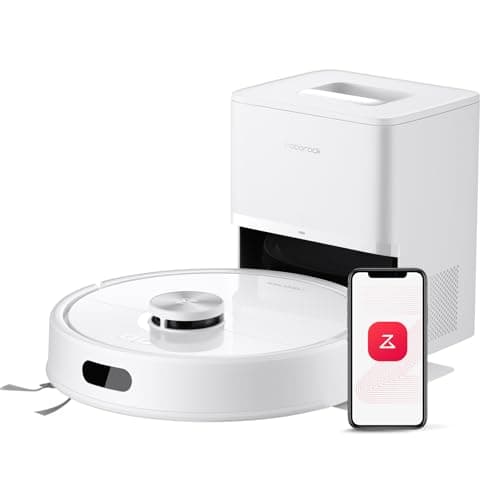
Roborock Q7 M5+10,000Pa, a self-emptying dock, and the only anti-tangle system here that treats the side brush as part of the problem.
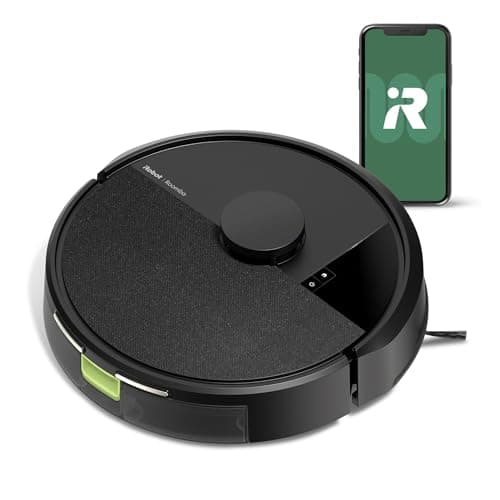
iRobot Roomba 105 VacThe lowest price at which you can buy genuine LiDAR mapping from a company that has been doing this for twenty years. It publishes no suction figure.
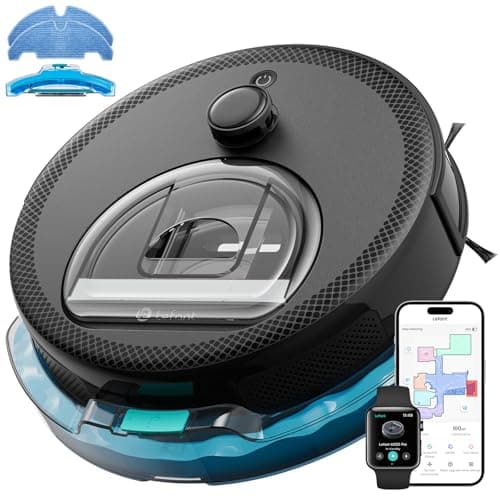
Lefant M330 ProPSD sensors that see cords and small objects, now with dToF mapping behind them. It publishes no suction figure at all, which is the trade.
If you work through this page and the robot is the right half of the answer, these are the four we would actually buy. Scores from the published rubric on How We Pick.
Four things a cordless does that no robot here can
1. Stairs
No robot vacuum on this site climbs stairs. Not one. The cliff sensors every machine here carries exist specifically to stop it falling down a staircase, and that is the entire extent of the relationship. If your home has two levels, a robot cleans the floors on each level once you carry it there, and the stairs themselves stay dirty forever.
For a household with a shedding animal this is usually the deciding fact on its own. Stair treads collect hair faster than any floor in the house and they are the hardest surface to clean without a machine designed for it.
2. Upholstery, mattresses and the car
A robot is a floor device. A cordless stick usually breaks down into a handheld with a brush tool, which makes sofas, mattresses, stair treads and a car interior all reachable with one machine. If the reason you want to buy a vacuum is that the sofa is covered in dog hair, a robot does not solve your problem at any price in this range.
3. Anything above the floor
Skirting boards, shelves, window tracks, the top of the fridge. A robot cleans a horizontal plane at floor level and nothing else.
4. A spill, right now
You knock over a bowl of cereal. A cordless is in your hand in ten seconds. A robot needs to be told where to go, and unless it is a mapping machine with room selection it will start a cycle and work its way round to the mess eventually. Even the mapping machines on this site take longer to dispatch than a stick takes to use.
Four things a robot does that no cordless can
1. It cleans when you are not there
This is the whole proposition and everything else is detail. A cordless vacuum cleans exactly as often as you decide to pick it up. A robot cleans on a schedule, including the days you get home late, the week you are ill, and the fortnight you are away.
2. Frequency, which is the variable that actually matters
A daily pass that lifts 70 percent of what is on the floor leaves less behind than a thorough weekly clean that lifts 95 percent, because the daily pass never lets six days of grit accumulate. This is the argument for a robot even though a robot is the weaker machine, and we make it at length on how often to run it. It is also why grit matters on soft floors - dragging a week of sand across a vinyl plank floor is what dulls it.
3. Under the furniture
A cordless stick has a head roughly ten centimeters tall on a long wand, so it reaches under a sofa only as far as your arm and the wand angle allow. The machines on this site that publish a height are 2.85 to 3.7 inches tall and drive underneath completely. The floor under a bed or a low sofa is usually the dustiest in the house, and a robot is the only one of the two that gets all of it - the published figures are set out on best for low furniture.
4. It can empty itself
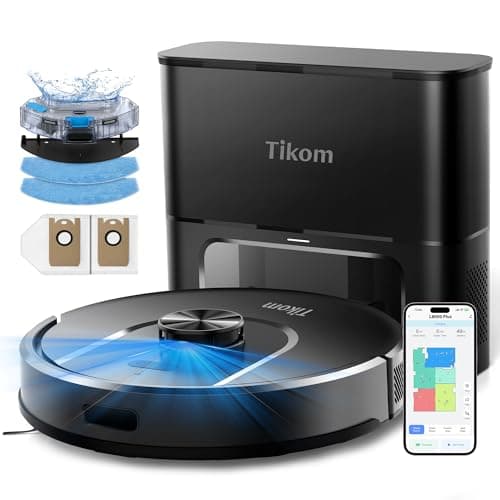
A cordless stick has a small bin you empty by hand, usually every use. Several machines here ship with a self-emptying dock and go weeks between anything you have to do - the Tikom L8000 Plus states a 3-liter bag at up to 90 days, and the Roborock Q7 M5+ a sealed 2.7-liter bag at 7 to 9 weeks. Whether that is worth paying for is its own question, covered on is a self-emptying dock worth it.
Where they genuinely overlap, and why that is the wrong place to choose
On hard floors and low-pile carpet - which is most of most homes - both formats do a perfectly good job, and comparing them on that surface produces a tie that tells you nothing. Neither one deep-cleans medium or high-pile carpet, and at this price that is a physics limit rather than a budget one; we explain why on best for carpet.
So do not choose on cleaning power. Choose on the shape of your home and on which surfaces are actually dirty, which is what the table below is for.
Which to buy first
Your home
Buy first
Why
One level, mostly hard floor, no pets
Robot
Nothing you own needs a handheld, and daily maintenance is the whole job
One level, hard floor, shedding pet
Robot
Hair on hard floor is exactly what a daily robot pass is good at - but see the sofa row
Stairs, any pet
Cordless
Stair treads are the dirtiest surface in the house and no robot here touches them
Sofas and mattresses are the problem
Cordless
A robot is a floor device and does not become anything else
Large single floor, over ~1,500 sq ft
Robot
Area is where pushing a machine yourself stops being realistic
Medium or high-pile carpet throughout
Cordless
Neither deep-cleans pile, but a cordless at least lets you press into it
Small flat, no storage space
Cordless
A robot needs a permanent parking footprint, and a dock machine needs more
You travel, or the house is empty all day
Robot
The one format that works while nobody is home
This assumes one purchase. If you can afford both, the order above is still the order we would buy them in.
A note on runtime figures, from both directions
Robot runtime figures on this site range up to a stated 220 minutes on the Lefant M3, and every one of them is quoted at the machine's lowest suction setting. That is the industry convention and it is worth knowing before you compare anything to anything. A machine that claims 150 minutes is not claiming 150 minutes of maximum-power cleaning.
We are not going to tell you what a cordless stick manages, because we do not test them and do not publish figures for them. What we will say is that the same convention applies across the whole vacuum industry, so if you are comparing a robot's runtime against a cordless machine's, check that you are reading two numbers measured the same way. Usually you are not.
For a robot the number matters less than it looks anyway, because the good ones recharge and resume - they return to the dock, charge, and carry on where they stopped. A cordless has no equivalent; when the battery goes, the cleaning stops. Our battery life guide covers what the figures mean in practice.
The honest answer: most people end up with both
Not as an upsell - as a description of what actually happens. The two machines occupy different roles. The robot is the maintenance layer that keeps the floor from ever getting bad. The cordless is the response layer for the spill, the stairs, the sofa and the car.
If you are buying both over time, buy the one that covers your worst problem first and let the other wait for a sale. The mistake worth avoiding is buying a robot to solve a stairs-and-sofa problem, being disappointed, and concluding that robot vacuums do not work - when the machine was simply never designed for the job you bought it for.
10,000Pa, a self-emptying dock, and the only anti-tangle system here that treats the side brush as part of the problem.
Published specifications
Suction
10,000Pa HyperForceSource: Manufacturer listing
Navigation
PreciSense LiDAR with real-time mappingSource: Manufacturer listing
Self-emptying
2.7 L sealed bag, manufacturer states 7 to 9 weeksSource: Manufacturer listing
Anti-tangle
JawScrapers main brush plus a stated 0% hair-tangling side brushSource: Manufacturer listing
Mopping
Vacuum and mop in one pass, 3 water flow settingsSource: Manufacturer listing
What it gets right
Both brushes are designed against tangling. Every other anti-tangle claim here covers only the main brush, and the side brush is where long hair actually wraps
10,000Pa published, matching machines at three times the price
Roborock's app is the most capable in this group after iRobot's, and its maps survive furniture moves
Vacuums and mops in a single pass rather than two runs
What it gives up
2.7 L and 7 to 9 weeks is a shorter interval than the Tikom L8000 Plus manages
No structured-light obstacle avoidance at this price - that is the Q10's feature
Sealed bags are a recurring cost
The mop still cannot be washed by the dock
Our scoring
Suction9.0
Navigation8.5
Pet hair8.5
Running cost6.5
Setup8.0
Weights and the arithmetic behind the total are published on How we pick so you can recompute this yourself.
Who it is for: A shedding dog or a long-haired cat, on any floor type.
Skip it if: your home is cluttered at floor level. LiDAR maps walls, not socks and charging cables, and without obstacle avoidance this machine will eventually eat one.
3 suction levels, 3 water flow settingsSource: Manufacturer listing
What it gets right
Ninety days between bag changes is 50% longer than the Tapo docks and beats most flagships
Five saved maps handles a three-story house, which is unusual under $250
Separate no-mop zones, so you can keep it off a rug without banning it from the room
6,000Pa published, with automatic carpet boost
What it gives up
Bags are still a recurring cost, just a less frequent one
150 minutes is mid-pack, and a big home will need the resume feature to finish
A conventional main brush - no anti-tangle geometry is claimed
Tikom is a small brand; spare-part availability in three years is a genuine unknown
Our scoring
Suction8.0
Navigation8.0
Pet hair6.5
Running cost6.5
Setup7.5
Weights and the arithmetic behind the total are published on How we pick so you can recompute this yourself.
Who it is for: A multi-floor home where the dock is somewhere inconvenient and you want to visit it as rarely as possible.
Skip it if: you have long-haired pets. Nothing in this machine's published specification addresses hair wrap, and at a similar price the Roborock Q7 M5+ and the Ecovacs N20 Plus both name an anti-tangle mechanism.
Charging only - no self-emptyingSource: Manufacturer listing
Recharge and resume
YesSource: Manufacturer listing
Wi-Fi
2.4 GHz required for setup and operationSource: Manufacturer listing
What it gets right
Real LiDAR mapping at $149 - two years ago this feature started around $400
Keep-out zones you draw in the app, which is the single most useful thing a map buys you
The Roomba app is the most mature in the category and the least likely to lose your map
Recharges and resumes, so a large floor plan is one job rather than three
What it gives up
iRobot publishes no absolute suction number. '70x the 600 series' is a comparison to a fifteen-year-old machine, not a specification
No self-emptying dock at this price - you empty the bin yourself
iRobot consumables cost more than the generic parts the budget brands use
Vacuum only. No mop, no water tank, no pretending otherwise
Our scoring
Suction6.0
Navigation8.0
Pet hair6.0
Running cost6.5
Setup8.5
Weights and the arithmetic behind the total are published on How we pick so you can recompute this yourself.
Who it is for: Someone who wants a map, an app that works, and a brand that will still be selling filters in five years.
Skip it if: you want a suction figure you can compare against anything else. If specifications are how you shop, a machine that refuses to publish one is a machine you cannot rank.
#4 - Best obstacle avoidance under $150Score 7.5/10
PSD sensors that see cords and small objects, now with dToF mapping behind them. It publishes no suction figure at all, which is the trade.
Published specifications
Suction
Not published as Pa. Three modes: Quiet, Standard, MaxSource: Manufacturer listing
Navigation
dToF navigation scanning to 15 m, with multi-floor mapping and route planningSource: Manufacturer listing
Obstacle avoidance
PSD (position sensitive device) detection of furniture, cords and small objectsSource: Manufacturer listing
Runtime
Up to 150 minutesSource: Manufacturer listing
Dustbin / water tank
450 ml visible dustbin, 200 ml refillable tank with a washable padSource: Manufacturer listing
Height
95 mm (3.7 in)Source: Manufacturer listing
Carpet handling
Avoids carpet in mop mode, boosts suction when vacuuming itSource: Manufacturer listing
Wi-Fi
Dual band, 2.4 GHz and 5 GHzSource: Manufacturer listing
What it gets right
PSD avoidance is named for the objects it detects - furniture, cords and small items - which almost nothing else at this price claims
dToF mapping with multi-floor maps, at a price where most machines still have no map at all
An anti-tangle suction port rather than a roller, so there is nothing for hair to wrap around
A 450 ml visible bin, so you can see when it needs emptying instead of guessing
What it gives up
No published Pascal figure anywhere on the listing, so its headline capability cannot be compared with anything
At 95 mm it is taller than the slimmest machines here and will not clear the lowest furniture
The mop is a washable pad on a 200 ml tank - maintenance mopping, not scrubbing
No self-emptying dock, so the bin is yours to empty
Our scoring
Suction5.5
Navigation8.5
Pet hair7.5
Running cost8.5
Setup8.0
Weights and the arithmetic behind the total are published on How we pick so you can recompute this yourself.
Who it is for: A cluttered hard-floor home where cords and toys stop the machine more often than dirt does.
Skip it if: you shop on suction figures. Lefant publishes none for this machine, so on a specification-led ranking it is unverifiable exactly where you would want a number.
Questions people actually ask
+−Should I buy a robot vacuum or a cordless stick vacuum?
If your home has stairs, upholstery that needs cleaning, or medium-pile carpet throughout, buy the cordless first - a robot cannot clean any of those. If it is one level of mostly hard floor or low-pile carpet, buy the robot first, because it cleans every day without you and frequency is what keeps a floor clean.
+−Can a robot vacuum clean stairs?
No. No robot vacuum on this site climbs stairs, and the cliff sensors they all carry exist to stop them falling down one. If stairs are a significant part of your cleaning problem, a robot does not address it at any price in this range.
+−Is a robot vacuum better than a cordless vacuum?
Neither is better - they do different jobs. A cordless cleans better wherever you point it and cleans only when you push it. A robot cleans a floor less thoroughly per pass but does it every day, including under furniture you cannot reach, and some empty themselves for weeks at a time.
+−Do I need both a robot vacuum and a cordless vacuum?
Most people end up with both, because they cover different roles: the robot is daily floor maintenance, the cordless handles stairs, sofas, spills and the car. If you are buying over time, buy whichever covers your worst problem first.
+−Can a robot vacuum replace a cordless vacuum?
Only if everything you need cleaned is floor. A robot is a floor device and does not do stairs, upholstery, mattresses, shelves or car interiors, so in a home with any of those it supplements a handheld rather than replacing one.
+−Which is better for pet hair, a robot or a cordless?
Both, for different parts of the problem. Hair on hard floors is exactly what a daily robot pass handles well, and brush design matters more than suction there. Hair driven into a sofa, a mattress or stair treads needs a handheld with a brush tool, which no robot here provides.
Sources
Every specification quoted above was read off one of these documents on the date shown. Where a manufacturer does not publish a figure, this site says "Not published" rather than estimating it.
Availability check, 2026-09-26All four machines ranked on this page were re-read from their live listings on the day of publication and confirmed in stock and purchasable new. No specification or price for any cordless stick vacuum is published on this page, because this site does not test or track them.