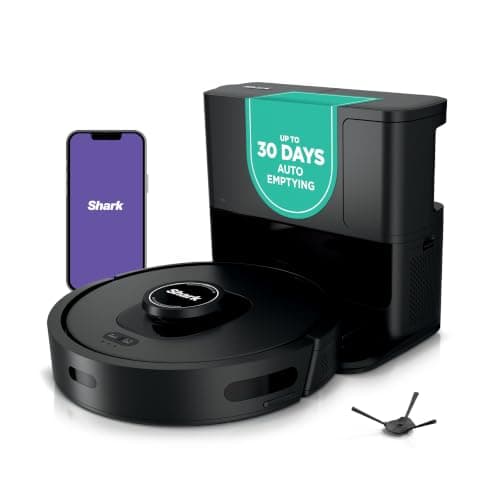
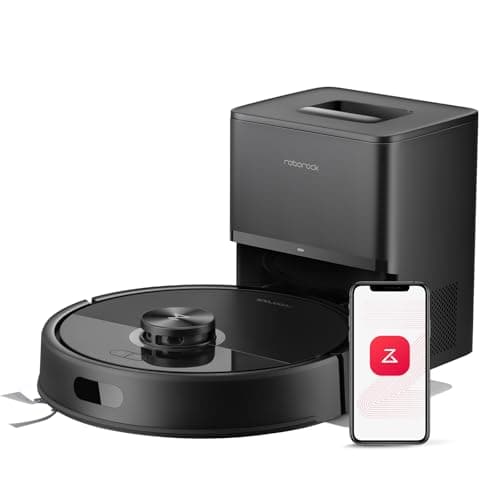
Both empty themselves, both map with a laser, both cost about the same. One of them will not tell you how hard it pulls, and the other will bill you for dust bags forever.
By Scooter M., Enthusiast - published October 31, 2026
We have not tested these machines. Everything here comes from published specifications, manufacturer manuals and retailer listings, all cited below. Prices last verified October 31, 2026.
How this is funded: if you buy through a link here we may earn a commission, at no extra cost to you. It does not change which machines we recommend or what we say about them. Full disclosure.
For most homes, buy the Roborock Q7 M5+ - our review. It publishes 10,000Pa where Shark publishes nothing at all, and it is one of only two machines on this site whose anti-tangle design covers the side brush as well as the main brush - which is where long hair actually wraps. Buy the Shark AI Ultra AV2501S - our review - if you would rather never buy a dust bag: its base is bagless and true HEPA, filtering 99.97% down to 0.3 microns, so the dock costs nothing to keep running and is the better answer in a dust-sensitive household. The Shark's catch is its dock interval - 30 days against the Roborock's stated seven to nine weeks.
This pairing comes up because the two machines land within about thirty dollars of each other, both empty themselves, and both map with a laser - so the usual tie-breakers are gone and what is left is a genuinely clean trade between two different philosophies.
#
Product
Best for
Score
Price
01
Roborock Q7 M5+10,000Pa, a self-emptying dock, and the only anti-tangle system here that treats the side brush as part of the problem.
Shark AI Ultra AV2501SShark's step-up machine, discounted hard and now well under the ceiling. LiDAR mapping, a bagless HEPA dock and a self-cleaning brushroll - and still no published suction figure.
Both machines scored on the published rubric from How We Pick: suction 25%, navigation 25%, pet hair 20%, running cost 20%, setup 10%. Editorial judgments about published specifications, not test results.
The criteria, before either machine
When two machines share a price, a dock and a navigation class, most comparison criteria cancel out. Four decisions survive, in this order.
What the dock costs you forever. One takes a sealed bag you replace; one takes none. Over three years that gap is larger than the price difference between the machines, and it is the clearest thing on this page.
Whether the manufacturer publishes a suction figure at all. One prints a number you can argue with. The other prints an adjective. On a site that ranks published specifications, that is not a small difference.
What happens to hair. Both claim an answer and they are not the same answer - one redesigns the brush, the other strips it clean mechanically, and only one of the two says anything about the side brush.
How long between dock emptyings. Published intervals differ by more than double here, and the shorter one belongs to the machine with the better filtration, which is an awkward combination for the buyer it is aimed at.
Where these two are genuinely the same
Worth clearing out of the way, because it is most of the machine. Both empty themselves into a base, which is the feature that decides whether a robot vacuum keeps working in month six. Both map with a 360-degree laser rather than bouncing, so both support scheduling, room selection and no-go zones drawn in an app - the argument for that is on is LiDAR worth it. Both take voice control through Alexa and Google Assistant. Both are round, so neither gets properly into a corner, and both sit in the same part of this site's price range.
Read from each manufacturer's own listing on 2026-10-31
Roborock Q7 M5+
Shark AI Ultra AV2501S
What it means
Published suction
10,000Pa HyperForce
Not published - Shark states "powerful suction"
The single biggest difference in what you can verify before buying
Dock type
2.7 L sealed bag
Bagless, emptied by hand
A consumable forever against a chore forever
Stated dock interval
7 to 9 weeks
30 days
Roughly double, in the Roborock's favor
Dock filtration
Sealed bag, no micron figure published
True HEPA, 99.97% down to 0.3 microns
The Shark's real advantage, and the reason it exists
Anti-tangle
JawScrapers main brush plus a stated 0% hair-tangling side brush
Self-cleaning brushroll
Two different mechanisms; only Roborock addresses the side brush
Pascal figures have no shared test standard between manufacturers, so Roborock's 10,000Pa cannot be compared directly against another brand's number - but it can be compared against a brand that prints nothing. Where a figure is not published we have written that rather than estimating it. Live prices on the cards above are re-read from the retailer daily.
The dock is the whole argument
Everything else here is a detail. The Roborock empties into a 2.7-liter sealed bag that Roborock states lasts seven to nine weeks; the Shark empties into a bagless bin with a true HEPA filter that Shark states holds 30 days. So the Roborock asks you to buy a consumable roughly six to seven times a year and never handle the dust; the Shark asks you to tip a bin out roughly twelve times a year and never buy anything.
Which is better depends entirely on why you wanted a dock. If the dock is about convenience, the Roborock wins on interval and the bag cost is the price of that convenience - the three-year arithmetic is on running costs. If the dock is about dust, the calculus inverts twice over: the Shark's base filters to a published 0.3 microns where Roborock publishes no micron figure at all, but a bagless bin has to be tipped out by hand, and that is exactly the moment a sealed bag exists to avoid.
The number Shark will not print
Shark describes this machine's suction as powerful and stops there. No Pascals, no air watts, nothing. That is not evidence the machine is weak - Shark has been making vacuums for a long time and its brushroll engineering is genuinely good - but on a site that ranks published specifications it is a real cost, and it is why this machine scores lower than its hardware might suggest. A specification nobody will print is a specification you cannot argue with.
The Roborock prints 10,000Pa, which matches machines at three times the price. Treat that number with the standing caveat - there is no shared Pascal test standard between manufacturers, so it is comparable within Roborock's range and only loosely across brands - but a published figure you can hold a manufacturer to beats an adjective. The mechanics are in what Pa suction actually means, and the whole published field is on the highest published suction under $300.
Hair: two mechanisms, one of them more complete
Both machines claim an answer to hair wrap and the claims are not equivalent. Shark fits a self-cleaning brushroll - a comb strips hair off the roller as it turns, which is a real mechanism and a good one. Roborock fits a JawScrapers main brush plus a stated 0% hair-tangling side brush.
The difference that matters is the side brush. It is the thin, slow, unshrouded arm at the front corner, and it is the worst hair-wrap point on any robot vacuum - Shark's self-cleaning mechanism is on the main roller and nothing is claimed for the side brush. For a long-haired or shedding household that is the deciding detail, and it is why best for pet hair and best for long human hair both put the Roborock ahead.
What neither of them does
Neither sees objects on the floor. Both map walls with a laser; neither publishes structured-light obstacle avoidance, which under $300 belongs only to the Roborock Q10 S5+. A charging cable will eventually catch either of these out - the mechanisms are separated on obstacle avoidance, ranked.
Neither will deep-clean medium or high-pile carpet. That limit is weight and battery rather than price, and it applies the same to a $900 machine. The honest threshold is on do robot vacuums work on carpet.
Neither gets into a square corner. Both are round. Best for corners and edges explains what a side brush can and cannot do about that.
Neither publishes a body height we can cite, so if the point of your purchase is getting under a low sofa, check best for low furniture instead - it ranks the machines that do publish the figure.
What we did not verify
We have not handled either machine. Every figure above is the manufacturer's own, read off the two listings on the date in the sources: Roborock's 10,000Pa, its 2.7-liter bag and seven-to-nine-week interval, its JawScrapers and 0% hair-tangling side brush; Shark's true HEPA 99.97% at 0.3 microns, its 30-day bagless base, Matrix Clean navigation, self-cleaning brushroll and 120-minute runtime. We have not measured suction on either, cannot compare Shark's unpublished figure against anything, have not timed an emptying cycle, and have not tested how much dust a bagless bin releases when tipped out - nobody publishes that. Neither score is a test result; both are judgments about published specifications on the rubric set out on how we pick.
10,000Pa, a self-emptying dock, and the only anti-tangle system here that treats the side brush as part of the problem.
Published specifications
Suction
10,000Pa HyperForceSource: Manufacturer listing
Navigation
PreciSense LiDAR with real-time mappingSource: Manufacturer listing
Self-emptying
2.7 L sealed bag, manufacturer states 7 to 9 weeksSource: Manufacturer listing
Anti-tangle
JawScrapers main brush plus a stated 0% hair-tangling side brushSource: Manufacturer listing
Mopping
Vacuum and mop in one pass, 3 water flow settingsSource: Manufacturer listing
What it gets right
Both brushes are designed against tangling. Every other anti-tangle claim here covers only the main brush, and the side brush is where long hair actually wraps
10,000Pa published, matching machines at three times the price
Roborock's app is the most capable in this group after iRobot's, and its maps survive furniture moves
Vacuums and mops in a single pass rather than two runs
What it gives up
2.7 L and 7 to 9 weeks is a shorter interval than the Tikom L8000 Plus manages
No structured-light obstacle avoidance at this price - that is the Q10's feature
Sealed bags are a recurring cost
The mop still cannot be washed by the dock
Our scoring
Suction9.0
Navigation8.5
Pet hair8.5
Running cost6.5
Setup8.0
Weights and the arithmetic behind the total are published on How we pick so you can recompute this yourself.
Who it is for: A shedding dog or a long-haired cat, on any floor type.
Skip it if: your home is cluttered at floor level. LiDAR maps walls, not socks and charging cables, and without obstacle avoidance this machine will eventually eat one.
Shark's step-up machine, discounted hard and now well under the ceiling. LiDAR mapping, a bagless HEPA dock and a self-cleaning brushroll - and still no published suction figure.
Published specifications
Suction
Not publishedSource: Manufacturer listing
Navigation
360-degree LiDAR home mapping with Matrix CleanSource: Manufacturer listing
Shark publishes no suction figure, so its headline capability cannot be ranked against anything
30-day dock capacity is HALF what Shark's own Matrix Plus publishes
120-minute runtime is beaten by machines here costing a third as much
Still no published suction figure
Our scoring
Suction6.5
Navigation8.0
Pet hair8.0
Running cost8.0
Setup7.5
Weights and the arithmetic behind the total are published on How we pick so you can recompute this yourself.
Who it is for: Somebody who wants LiDAR mapping and a dock with no bag to buy, and who is willing to accept a brand that will not print a suction number.
Skip it if: you want a long gap between dock emptyings. On that published number this is worse than Shark's own Matrix Plus, and worse than most bagged docks at this price.
Questions people actually ask
+−Shark AI Ultra or Roborock Q7 M5+?
The Roborock for most homes - it publishes 10,000Pa where Shark publishes no suction figure at all, and its anti-tangle design covers the side brush as well as the main brush. The Shark if you would rather never buy a dust bag: its base is bagless and true HEPA at 99.97% down to 0.3 microns. The trade-off is the interval, 30 days against Roborock's stated seven to nine weeks.
+−Does the Shark AI Ultra need dust bags?
No. The self-empty base is bagless, so there is no consumable to reorder - over three years that is a bigger saving than the price difference between these two machines. You tip the bin out by hand instead, roughly monthly on Shark's stated 30-day capacity.
+−How much suction does the Shark AI Ultra have?
Shark does not publish a figure. The listing describes powerful suction and stops there - no Pascals, no air watts. That is not proof the machine is weak, but it cannot be ranked against the Roborock's published 10,000Pa, and on a site built on published specifications that is a real cost.
+−Which one is better for pet hair?
The Roborock, narrowly but for a specific reason. Both answer hair wrap - Shark with a self-cleaning brushroll that strips the roller as it turns, Roborock with a redesigned main brush plus a stated 0% hair-tangling side brush. Only Roborock says anything about the side brush, and that is where long hair wraps worst.
+−Which has the better dock for allergies?
Shark publishes the finer figure - true HEPA, 99.97% down to 0.3 microns, where Roborock publishes no micron rating for its bag. But the Shark's bin is bagless and has to be tipped out by hand, which releases dust a sealed bag would contain. For a household where somebody genuinely reacts, a sealed-bag machine is usually the better answer than either of these.
+−Does the Shark AI Ultra mop?
No. It is vacuum only - no water tank and no pad. The Roborock Q7 M5+ vacuums and mops in a single pass with three water levels, though the pad is dragged rather than scrubbed and it does not lift when it reaches carpet.
Sources
Every specification quoted above was read off one of these documents on the date shown. Where a manufacturer does not publish a figure, this site says "Not published" rather than estimating it.
Availability and specification check, 2026-10-31Both ASINs resolved through the Amazon Creators API on the day of publication from the raw offersV2 payload: each returned a New-condition buy-box offer with IN_STOCK availability and a catalog image. The Shark listing was additionally re-read in full the same day (9 feature bullets), which is where the 30-day capacity, the true HEPA 0.3-micron figure, Matrix Clean, the self-cleaning brushroll and the 120-minute runtime come from.